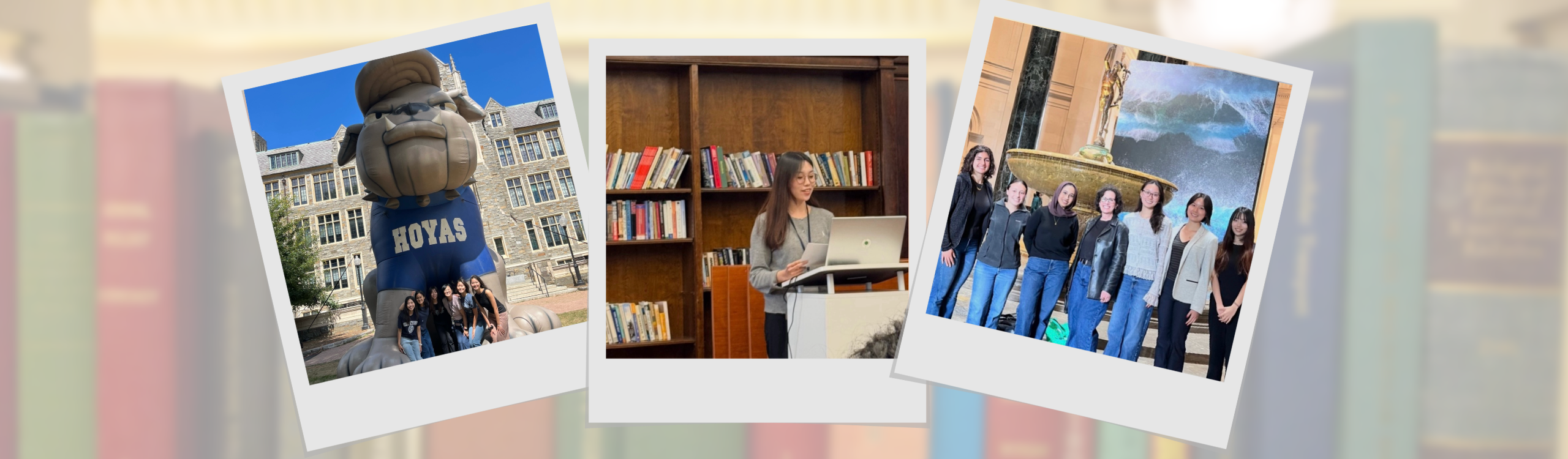
7,000 Miles From Home, Korean Fulbright Recipient Built Community at Georgetown
Ever since she began reading English-language novels in middle school in Seoul, South Korea, Seyoung Kim (G’26) hoped to study literature in the United States.
She was fascinated by American authors like Edgar Allan Poe, who illustrate the physical and psychological health of society through the lens of fiction. Kim’s dual interests in literature and medicine led her to a niche in the medical humanities.
A Fulbright Foreign Student Program grant, paired with an acceptance to Georgetown’s M.A. in English program, made her dream a reality. Kim’s first trip to the U.S. coincided with her move to D.C. in 2024.
“It wasn’t easy, but I had real passion for the field I’m studying in and the research that I wanted to do,” Kim said.
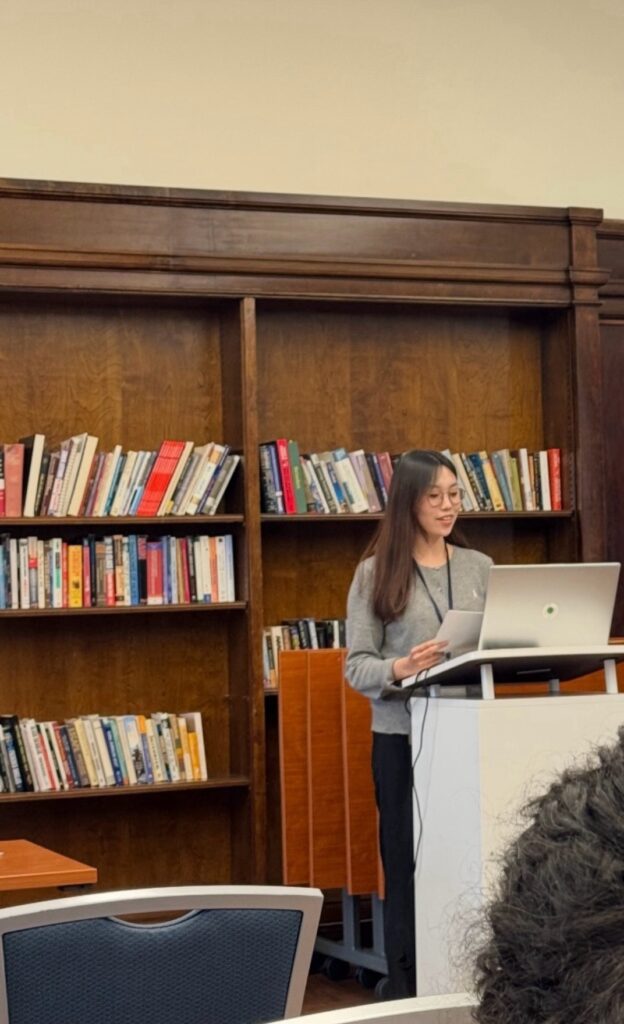
Seyoung Kim presents her research. (Courtesy of Seyoung Kim)
Georgetown’s interdisciplinary emphasis has given Kim the opportunity to pursue advanced research in the medical humanities. Her thesis focuses on how 19th- and 20th-century literature portrayed health stigmas in the American South and influenced public perception of the region.
Kim graduates this spring with numerous accolades for her thesis-related research, including a Georgetown Medical Humanities Fellowship, a voters’ choice award at a campus-wide research showcase and presentations at local and regional symposia.
Mentorship and encouragement from her department, and connections around Georgetown, made these accomplishments possible and spurred Kim’s acceptance to a Ph.D. program, she said.
“Georgetown’s vibrant community and the immense support from the English department helped me build lasting relationships and maximize and actualize my potential in my research and studies,” Kim said. “I will cherish these wonderful memories at Georgetown.”
Support for Faith and Research
When applying to master’s programs in the U.S., Kim looked for communities that kept her connected to her culture and faith. She especially appreciated the presence of an Asian Baptist Student Koinonia (ABSK) Christian fellowship group at Georgetown.
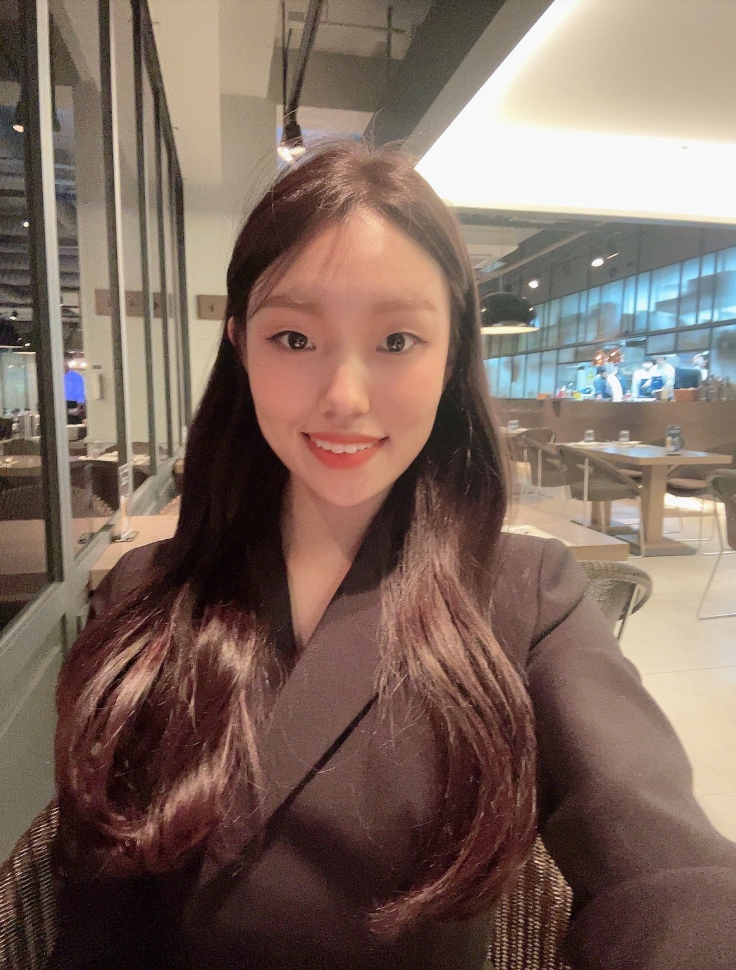
Seyoung Kim (Courtesy of Seyoung Kim)
“It was great to connect from my undergrad group to the one at Georgetown,” said Kim, who earned her bachelor’s from Ewha Womans University, a Christian university in Seoul. “The group has been just like a family.”
She also sought a strong, thesis-based master’s program that would offer research support for her interests in medicine and literature.
Early in Kim’s program, a faculty member introduced her to the Medical Humanities Initiative, a cross-campus collaboration between the College of Arts & Sciences and the Georgetown University Medical Center. The initiative supports studies of the connections between medical care and its sociocultural and historical contexts, offering interdisciplinary courses, an undergraduate minor and research mentorships and fellowships.
Kim earned a Medical Humanities Research Fellowship in 2025 to support a project related to her thesis. She had already built a website sharing cancer patients’ experiences for a Digital Humanities class — a project that also won a Georgetown Library Showcase award — and decided to continue working in a digital format through the fellowship.
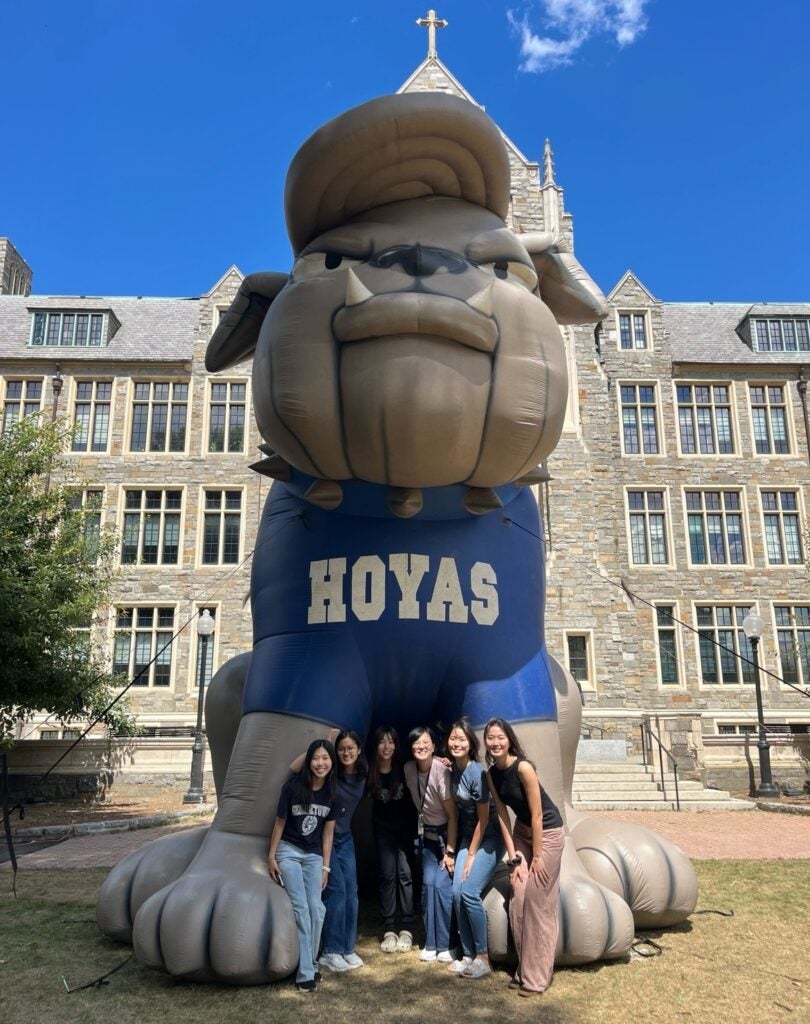
Kim poses with a group of friends in front of an inflatable Jack the Bulldog. (Courtesy of Seyoung Kim)
The result was an interactive story map that visualizes literary representations of hookworm disease in the American South, which Kim presented at the initiative’s Spring Research Showcase.
“I’m really interested in digital technologies in relation to medical humanities,” Kim said. “This interest developed at Georgetown, especially after I took Professor Phil Sandick’s Digital Humanities and Rhetoric: Theory, Method and Practice course that really motivated me to think about how to use technology to increase the reach of my research.”
‘Walking Together’ in the Thesis Process
While working on her fellowship project, Kim spent much of the past year finishing her master’s thesis.
Kim’s research proposes that disease narratives in Harriet Beecher Stowe’s 1856 novel Dred: A Tale of the Great Dismal Swamp and William Faulkner’s 1931 novel Sanctuary reveal and contest stereotypes of enslaved African Americans and poor whites as disease carriers in 19th- and 20th-century public opinion. Depictions like these continue to influence perceptions of the American South today, Kim said.
“The American South was portrayed as moving backward, in terms of health and well-being,” Kim said. “The South’s reputation for poor health is sometimes interpreted as a mobility disorder. I’m interested in the bodily mobility or bodily inaction of impoverished characters that are portrayed in these novels, and I looked at depictions of narrative mobility that reveal and test this stigmatization.”
Her cohort’s support has made a world of difference while working on her thesis, Kim said. Some of her favorite memories at Georgetown involve weekly workshop sessions with her cohort in the Leavey Center Starbucks and the English department’s graduate lounge.
“I was not walking alone in my thesis, but walking together with friends,” Kim said. “I had quite a lot of struggles in my thesis, and I was able to openly share them and gain feedback from my fellow students and my advisor.”
Seyoung Kim’s favorite study spaces around campus
Lauinger (Lau) Library
Five floors of quiet and group study areas, with a dedicated graduate lounge.
Learn about LauBioethics Research Library
A cozy, historic space and destination for bioethics scholars worldwide.
Browse the Bioethics LibraryHealey Family Student Center
Hit the books in group and individual study spaces and enjoy student amenities.
Study and Student ProgrammingProfessor Lori Merish, director of graduate studies for the English department and Kim’s thesis advisor, said Kim has deepened connections between distinct academic communities at Georgetown while making fascinating headway in her research area.
“Her commitment to interdisciplinary research, and to learning all she can in her areas of interest as a graduate student, are quite remarkable,” Merish said. “She is an immensely energetic and dedicated researcher and scholar, and deeply passionate about her intellectual interests. She has contributed a great deal to Georgetown’s graduate community.”
‘Georgetown Was the Best Community’
This summer, Kim is moving to the Houston area to pursue a Ph.D. in English from Rice University. She plans to continue exploring the intersections of literature and medical and digital humanities during her doctoral studies.
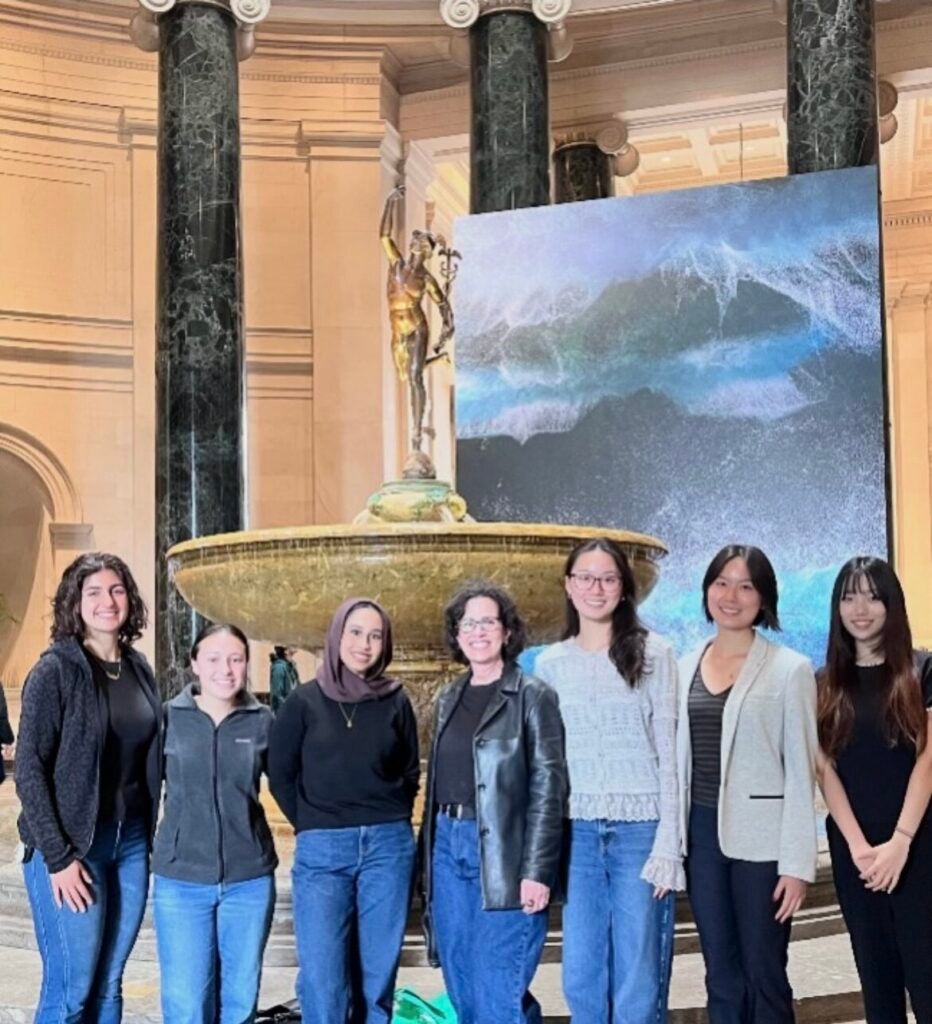
Kim, far right, visits the National Gallery of Art with Assistant Professor Julia Langley, from the Georgetown University School of Medicine, and members of the Medical Humanities Student Interest group. (Courtesy of Seyoung Kim)
More immediately, Kim looks forward to introducing her family to Georgetown’s campus this month when they fly in from South Korea to watch her graduate.
Reflecting on her time at Georgetown, Kim is grateful for the mentors, peers and campus resources that encouraged her interests and challenged her to develop new technical skills. Her support system spans the Hilltop Campus, from Medical Center faculty in the Medical Humanities Initiative to Library Research Services librarians with subject matter expertise.
“All of the different aspects and approaches that I could learn about literature, I was able to learn them at Georgetown,” Kim said. “I cannot express how much help I got from Dr. Lori Merish, including her exceptional mentorship, guidance and support for both my studies and thesis. And my cohort really broadened my perspective on the qualities I should gain as a scholar. Georgetown was the best community.”