At Georgetown, Interreligious Understanding Is a Way of Life — And It’s Made Me a Better Scholar and Believer
This student-contributed piece was written by Mideum Hong (G’26), who graduates this year with his Ph.D. in Theological and Religious Studies from the College of Arts & Sciences.
Hong, an international student from South Korea, was raised in a devoutly Protestant household, and his curiosity for interfaith religious practices led him to study theology. He researched the history of Jesuit missions in East Asia during his master’s program at Princeton Theological Seminary and at one point considered becoming a Jesuit priest.
A desire to learn in the Jesuit tradition brought Hong to Georgetown. Through engaging in interreligious dialogues across the university, Hong writes that he has broadened his academic ecumenical perspective and developed a greater understanding of his own faith.
I came to Georgetown University as a doctoral candidate in 2020.
I had many reasons for choosing Georgetown, but two particularly stood out: Georgetown’s Jesuit heritage and the theology department’s emphasis on religious pluralism and interreligious studies.
For me, these factors were deeply intertwined. I grew up in Seoul, South Korea, as the son of a Presbyterian pastor, and my early observations on Korea’s diverse faith traditions drew me to study theology throughout my academic career.
Korea is a religiously diverse society in which Catholicism, Protestantism and Buddhism are widely practiced alongside smaller new religious movements. Confucianism and shamanism also continue to play a central role in shaping Korean spiritual society. But even within this pluralistic context, Korean Protestant churches are often quite conservative and tend to view other religious traditions as objects of evangelization, not engagement.
As I pursued theology academically, I found myself increasingly drawn to questions about other religious traditions and Christianity’s relationship with them. How, I wondered, is interfaith dialogue created and sustained?
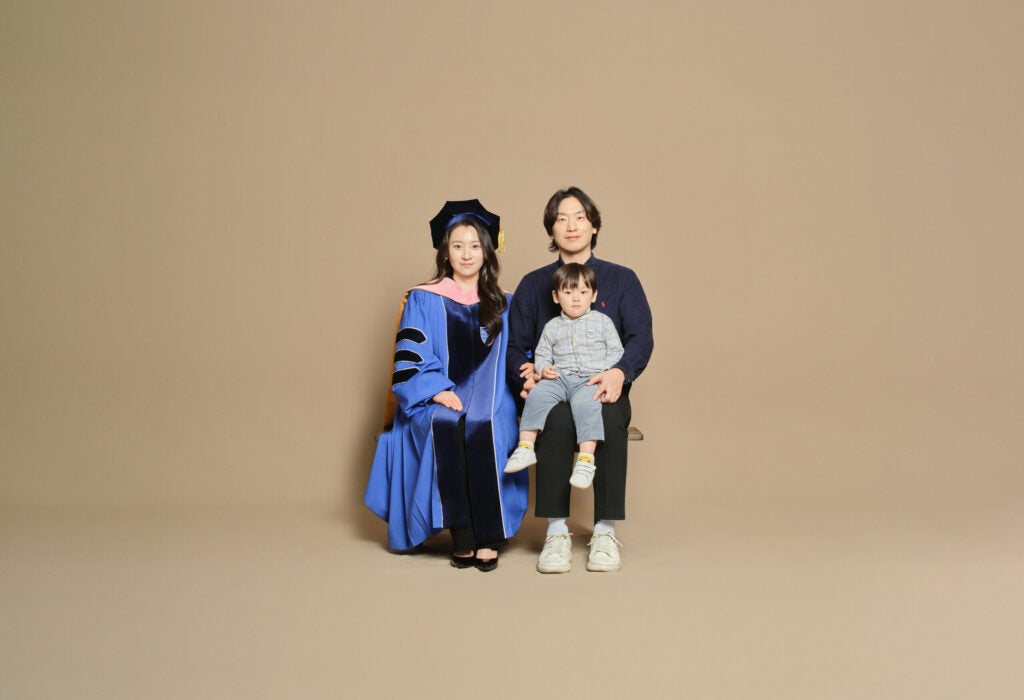
Mideum Hong with his son Glenn and his wife Dayeon Kim celebrating Kim’s graduation with her Doctor of Musical Arts. (Photo courtesy of Mideum Hong)
During my master’s program, I read the novel Deep River by Shūsaku Endō and identified with the character Ōtsu, who wrestles with the idea of a “form of Christianity that suits the Japanese mind.” Around the same time, my advisor introduced me to Ignatian spirituality, particularly the idea of “finding God in all things.”
These concepts encouraged me to reflect more seriously on the possibility of an “Asian-Christian” identity — one that seeks God within the religious traditions of Asia — and to both find this identity within myself and study it as a broader concept.
I became deeply interested in the history of the Jesuit mission in Asia, especially how some Jesuit missionaries sought to introduce Christianity by socially integrating themselves into the local culture. Although their primary goal was conversion, I see the Jesuits in early modern India and China as pioneers in the deeper study of Asian religions and interreligious engagement.
My immersion into Jesuit history nearly set me on a course to becoming a Jesuit priest — a path that shifted once I met my wife. Life led me to pursue a doctorate instead, and naturally, I sought a Ph.D. program where I could pursue both Jesuit and interreligious studies in greater depth.
An Inspiring Community of Scholars
From the moment I applied, I knew Georgetown was the ideal university for me.
During my six years here, I’ve gratefully explored the intersections and divergences of diverse religious traditions under the guidance of seasoned theological scholars. I sought out Professor Peter C. Phan as my advisor, inspired by his profoundly influential work in interreligious theology and the history of the Jesuit mission in Vietnam.
Another reason I chose Georgetown was the opportunity to contemplate Asian religious traditions outside of their relation to Christianity. I’ve studied Buddhism with Professors Brandon Dotson and Francisca Cho, Hinduism with Professor Ariel Glucklich, and Confucianism with Professor Philip J. Ivanhoe, while also engaging in interreligious studies with Professors Michael R. Slater and Leo D. Lefebure.
Through Georgetown’s in-residence Jesuit community, I connected with Fr. Brian Daley, S.J., and had the opportunity to take a directed reading course with him on Mariology, the study of the Virgin Mary, and Catholic devotion.
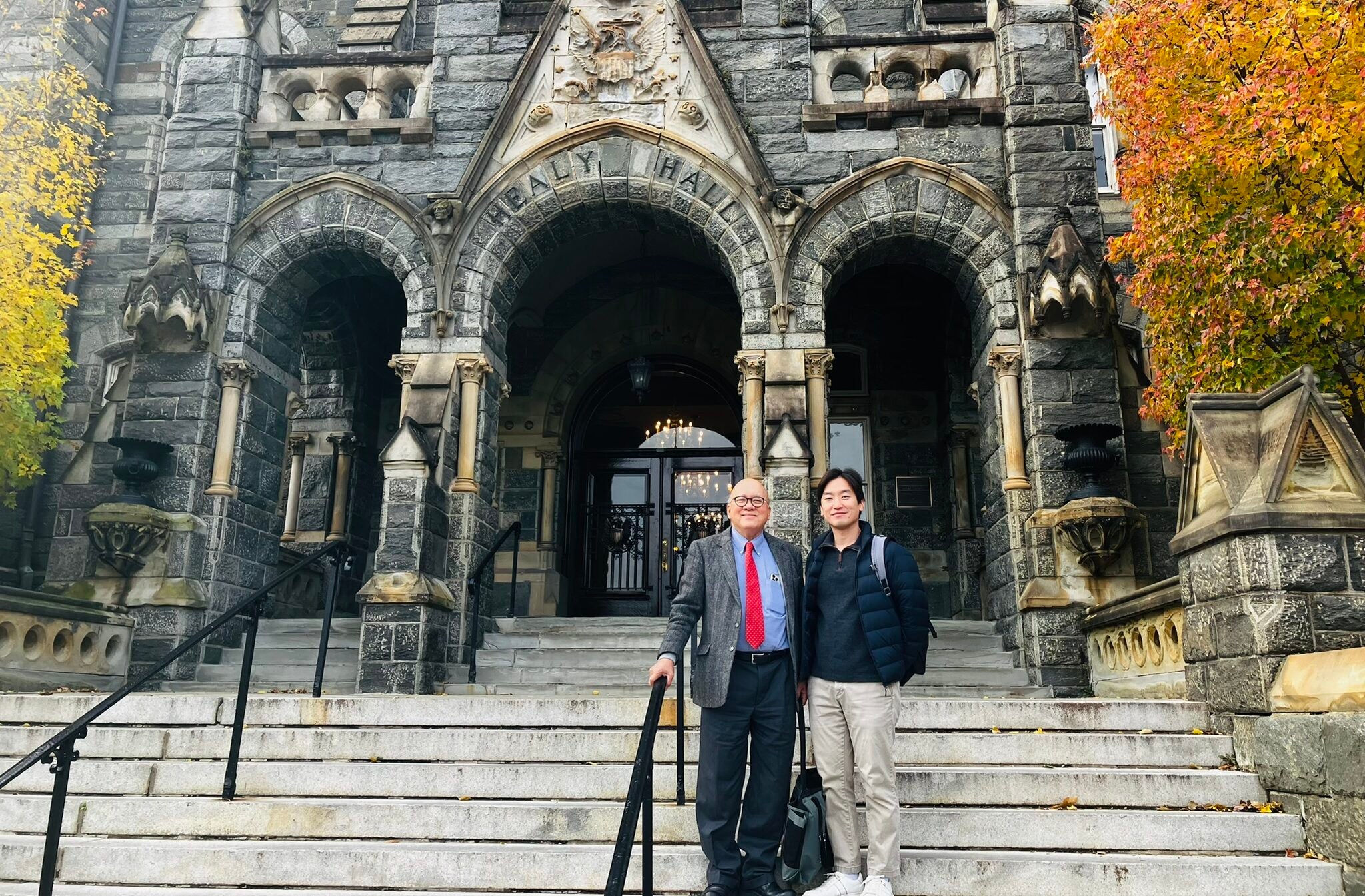
Mideum Hong, right, stands with his advisor Professor Peter Phan outside Healy Hall on Georgetown’s campus. (Courtesy of Mideum Hong)
Beyond intellectual depth, the theology faculty demonstrate exceptional generosity and support outside the classroom. Even faculty members with whom I have not taken courses — such as Professors Andrew Prevot, Annalisa Butticci, and Erin Cline — have been consistently welcoming to and supportive of graduate students.
Every lesson and conversation with my faculty mentors guided me toward becoming the scholar and theologian I hope to be.
My doctoral research, overseen by Professors Phan, José Casanova, and Ivanhoe, focuses on the Confucian concept of filial piety in late Joseon-era South Korea. Filial piety refers to the reverent, grateful and loving attitude that a child should embody toward their parents.
In my dissertation, I argue that filial piety functions as a fundamental principle — indeed, an existential framework — of being human within Confucian society.
My research examines how the Christian reinterpretation of Confucian filial piety not only reoriented the meaning of being human toward God but also significantly shaped the devotional spirituality of Korean Catholics. Through focusing on early Korean Catholicism, I hope to show how Catholicism has been both globally connected and locally distinct.
My rigorous study of the historical dynamics of these interreligious encounters has illustrated that we in contemporary society can continue to learn from them.
The Buddhist idea of dependent origination, for example, encouraged me to understand human life as deeply relational and interconnected, shaped by our relationships, actions and responsibilities toward others. It taught me that maintaining open communication with those of different beliefs and backgrounds is vital to respecting the connectivity that we all share.
An Interfaith Epiphany
Looking back, my time at Georgetown has been uniquely formative. It has allowed me not only to study other religious traditions in depth, but also to cultivate a more reflective and dynamic understanding of my own faith. In that sense, my journey here has not simply been academic — it has also been deeply personal.
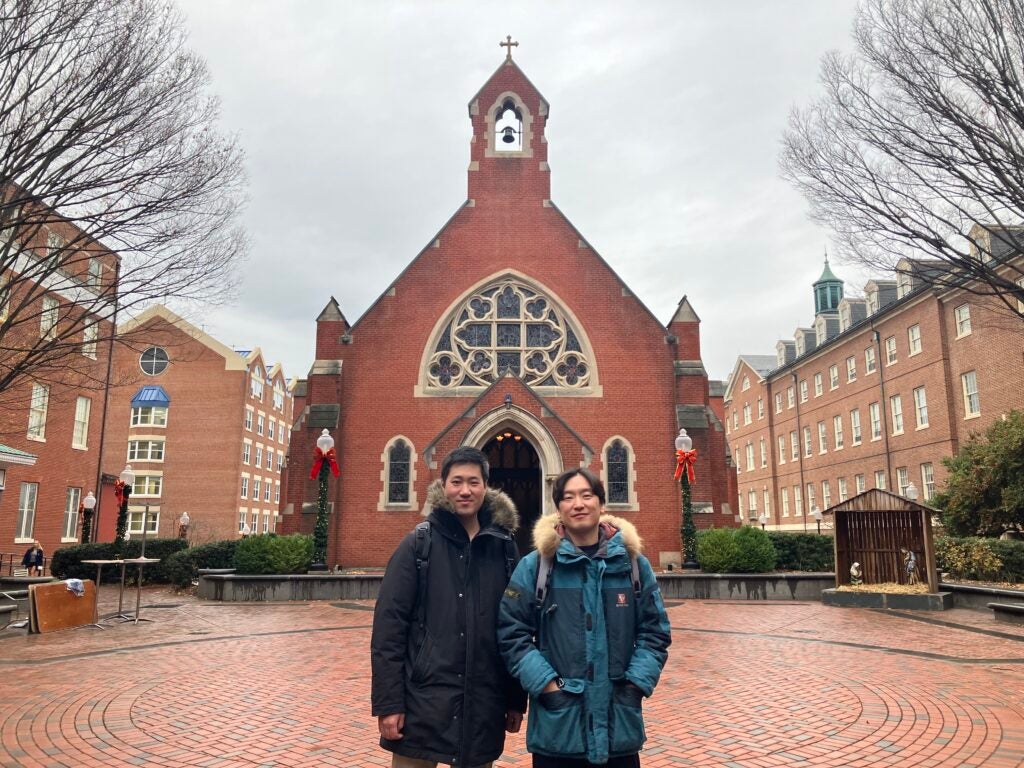
Mideum Hong, right, with Haewon Lee, a friend and a former doctoral student of the department of Theology and Religious Studies. (Courtesy of Mideum Hong)
Learning about other faith traditions has not only deepened my understanding of those traditions themselves but also helped me to better understand the people who live within them. It has made clear to me that religious doctrines do not exist merely as abstract ideas; they are embodied in the lives and practices of communities and individuals, including the people I have learned from and studied alongside at Georgetown.
I have learned about devotion to God from Hinduism, non-attachment from Buddhism and moral cultivation from Confucianism. My course on Marian doctrine opened my eyes to dimensions of Catholic devotion that had previously been unfamiliar to me as a Protestant.
At times, these newfound insights have required me to question or even unsettle beliefs I once held firmly. I have come to recognize moments like these as opportunities for growth, as true learning often comes from challenging and adapting your viewpoints.
Faith is not static; it develops over time and, at times, must be reshaped. However uncertain or uncomfortable that process may be, I believe it is essential to both spiritual and intellectual maturation. And I feel very fortunate to have expanded my horizons on both counts at Georgetown.