
Former Federal Employees Find Renewed Purpose in Georgetown Graduate Programs
For much of her federal career, infectious disease scientist Bobbi Barr (G’26)’s work uniform was a hazmat suit.
Covered head-to-toe in aseptic gear, Barr handled samples of some of the world’s most dangerous and currently incurable viruses — including ebola, Nipah and HIV — in labs at the National Institute of Allergy and Infectious Diseases and later the U.S. Food and Drug Administration.
With each assay she ran, Barr was advancing U.S. efforts to prevent future pandemics and discover cures for pathogens that threaten millions globally. When she was laid off in April through a federal reduction in force, Barr sought a new opportunity in her field that would similarly reward and challenge her.

Georgetown master’s student Bobbi Barr is studying biohazardous threat agents & emerging infectious diseases. (Photo courtesy of Bobbi Barr)
She had considered attending graduate school before, but few universities offered programs in her specialty and she was nervous about returning to the classroom. Learning about Georgetown’s master’s tuition scholarship program for recent federal workers encouraged her to take the plunge.
“It showed me that Georgetown is committed to supporting federal workers,” said Barr, who started her master’s in biohazardous threat agents & emerging infectious diseases this fall. “I felt like they saw us.”
Georgetown’s tuition scholarship program for federal civil government employees provides professionals at all career stages the opportunity to upskill or pivot their expertise through earning a master’s degree. Students like Barr say they enjoy sharing their professional insight with their peers while learning from experts in their fields.
Drawn together by a call to fulfill the common good, these grad students are turning their service into their next step.
Alisha Bi: From the Department of Defense to Capitol Hill
From the start of her federal career, former contractor Alisha Bi (G’27) had her five-year plan mapped out: She would work at the Defense Innovation Unit (DIU) as an special assistant for three years, then pursue a full-time grad program at the intersection of national security and technology.
That plan worked down to a T.
Bi gained valuable knowledge and experience working at the DIU, a contractor of the Department of Defense that evaluates commercial technology for defense acquisitions. She worked directly under the office’s director and said she often accompanied him to meetings with foreign defense ministers, private-sector executives and legislators on Capitol Hill.

Georgetown master’s student Alisha Bi studies data science for public policy. (Photo courtesy of Alisha Bi)
“Getting to work with other public service-minded people was incredible, especially at these high levels,” Bi said. “It offered really great insight into what being in these offices is like.”
Bi voluntarily left her role in August to start her Master of Science in Data Science for Public Policy (MSDSPP) at Georgetown. The San Ramon, California, native wanted to stay in DC, close to internship opportunities and her friends, and said she liked that the MSDSPP program’s curriculum was “quantitatively rigorous.”
“I felt a need for technological literacy in government at all levels,” Bi said. “Everyone’s answer to everything was always AI, and it was always this pie-in-the-sky vision. The MSDSPP program focuses a lot on contemporary machine learning and data science techniques that I felt would give me a working literacy of what’s possible and what’s also, more importantly, ethical.”
Bi hopes to eventually land a public policy role where she can advise officials on appropriate AI usage in the government.
In the meantime, Georgetown’s tuition discount program makes grad school more affordable for her, especially while she’s studying full-time. Bi said applying for the discount was as easy as drafting a letter, having a former colleague sign it and then submitting the document to the university.
“The fact that Georgetown offers a program like this, and it’s a pretty generous one, I was really excited about,” Bi said. “I almost thought it was too good to be true.”
Anthony Badial-Luna: Financial Aid Analyst Finds Scholarship Support
Growing up in Lima, Ohio, Anthony Badial-Luna (G’26) saw drug addiction devastate his hometown and directly affect his loved ones.
He enlisted as a munitions systems specialist in the Air Force after high school to seek greater opportunities. Badial-Luna found purpose in the military’s community-oriented environment, which emphasizes service to others and collective well-being.

Anthony Badial-Luna, a Georgetown master’s student and Air Force veteran, studies addiction policy and practice. (Photo courtesy of Anthony Badial-Luna)
“The goal I’ve pretty much always had is to serve and help people,” said Badial-Luna, a master’s student in addiction policy and practice. “I just want to make a difference, even if it’s small, to make the world better.”
After leaving the Air Force, Badial-Luna graduated with his bachelor’s in 2024. He searched for federal jobs and landed at the Department of Education as a management and program analyst with the Federal Student Aid office in DC. He said he worked there for a month before he was let go in January during federal restructuring.
Initially, Badial-Luna considered searching for jobs in state governments. Then he learned of Georgetown’s graduate tuition benefit and its addiction policy program, a subject he felt passionate about.
“It was hard for me to imagine that I could get into Georgetown, so I never applied for grad school earlier,” said Anthony Badial-Luna. “But then I got terminated, and I thought, ‘You may as well shoot for the stars.’”
The program had extended its application deadline for former federal workers, and Badial-Luna was welcomed into its newest cohort. He said his favorite aspect of the program is the faculty, who have informed, intelligent and empathetic perspectives on addiction approaches.
After working to help others secure financial aid, Badial-Luna is now receiving multiple scholarships. In addition to the federal worker tuition discount, Badial-Luna is using his GI Bill® and Yellow Ribbon military education benefits to pursue his master’s degree.
Bobbi Barr: Infectious Diseases Aren’t Intimidating, But Grad School Was
When Barr lost her job as a contract scientist at the FDA in April, she had already been considering going to graduate school but doubted her ability to re-adopt an academic mindset.
“I’m not nervous working with ebola and other infectious diseases because I know what to expect from them,” said Barr, who earned her bachelor’s degree in 2017. “Going into graduate school, I didn’t know what to expect there.”
Leaving the federal workforce gave her the push she needed to submit her application, she said. Barr said she loves that her program lets her study what she loves in a location close to her family in Largo, Maryland.
The biohazard program emphasizes biosecurity and biodefense, teaching students how to analyze, anticipate and reduce the risk of chemical, biological, radiological and nuclear (CBRN) threat agents that could be used, incidentally or intentionally, to endanger global health.
It’s perfect for Barr, who hopes to rejoin a federal agency in a research role after she graduates.
“Being in the government led me to being at Georgetown, and I think this program is going to help me get back in,” Barr said.
Grady McGinnis: Pivoting to Public Policy
During his six years with the United States Agency for International Development (USAID), Grady McGinnis (G’27) evaluated U.S. development programs in Central America and later Eastern Europe to ensure they were effectively assisting local communities.
“I liked the idea of combining what I was very interested in — social science, economics and data analysis — with foreign affairs,” said McGinnis, who started his Master of Public Policy (MPP) at Georgetown this fall.
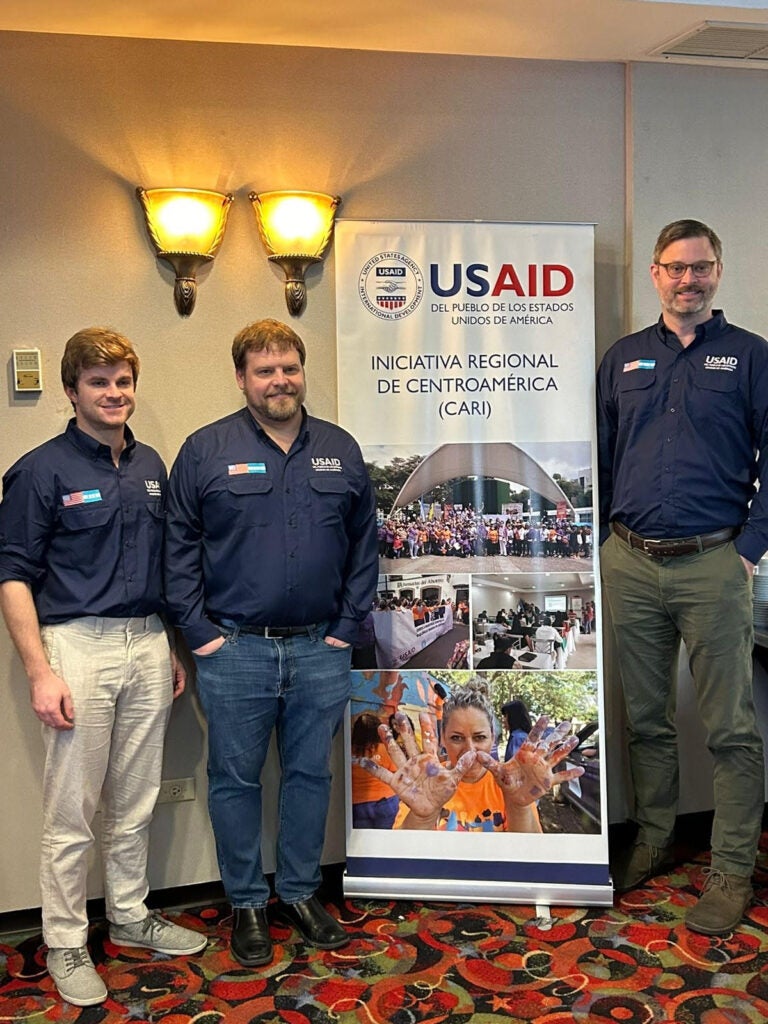
Grady McGinnis, left, is a former USAID employee and a current master’s student in public policy at Georgetown. (Photo courtesy of Grady McGinnis)
When the agency was shuttered this year, McGinnis found himself facing a competitive and uncertain job market for international development professionals in DC. Maybe, he thought, it was time to go to grad school for a policy-focused program.
He applied to universities in DC and New York City, but none of them felt like a good fit and the cost seemed prohibitive, he said.
A friend told McGinnis about Georgetown’s federal worker tuition benefit, and he reached out to the McCourt School of Public Policy to learn more. A program contact told him he was eligible for additional scholarships through the school, and after talking with program leadership and other policy professionals, McGinnis was reassured that Georgetown was right for him.
“I still want to work in politics and public service,” McGinnis said. “And going to grad school at Georgetown provides the best opportunity for me to shift my career in a positive direction, where it’s somewhere new, but it’s also in DC, and it’s close to all my friends and what I’ve been working in so far.”
Grady, from Broomfield, Colorado, appreciates that Georgetown’s MPP program emphasizes economic and statistical proficiency so its future policy professionals are equipped to effectively assess their impact. He recently secured an internship at AVOQ, a public affairs firm with a strong background in government relations.
“I’ve learned so much about the industry and what makes good advocacy work and good lobbying,” Grady said.
Geraud Bisimwa: Linking Democracy and Public Health
Born in Bukavu, Democratic Republic of the Congo, during the Second Congo War, Geraud Bisimwa (G’26) knows how unstable life can feel in conflict-torn countries with emerging economies.

Geraud Bisimwa is a master’s student in health and the public interest at Georgetown University. (Photo courtesy of Geraud Bisimwa)
That experience drew him to working in international development for the National Democratic Institute. As a program associate, he ran collaborative programs with local organizations in West African countries including Senegal, Niger and Burkina Faso to promote civic engagement and democracy.
“I would talk with people older than me who had a vision of what the African continent should be,” Bisimwa said. “I felt like they were the older versions of me, passing me the baton to make sure that we do the right thing.”
When Bisimwa was separated from his role in April, he felt the time was right to earn his master’s. He logged into Georgetown’s graduate application portal, where he’d started an application for an economics master’s program in 2023, and picked up where he’d left off.
This time, his application had a different destination: Health and the Public Interest. Bisimwa had begun working in international development for its economic aspect and fallen in love with its power to uplift others. He saw the potential to take that impact further in the health field.
“My program is a full bridge between what I’d been doing promoting democracy to something way more health policy-related,” Bisimwa said. “I’m going to have all the tools to engage in that.”
Bisimwa enjoys mentoring younger students in his program, who ask him questions about working in development and policy roles. For him, it’s one way of paying forward the generosity that he said Georgetown has shown him and other former federal employees.
“To Georgetown, I’d love to put out a ‘thank you,’” Bisimwa said. “I felt seen by being given this opportunity. You cannot put an amount on the value of being seen.”
- Tagged
- BGE
- biohazardous threat agents & emerging infectious diseases
- Biomedical Graduate Education
- federal employee tuition discount
- federal worker tuition discount
- HAPI
- Katie Rice
- Master of Public Policy
- Master of Science in Data Science for Public Policy
- master's in health and the public interest
- master’s in addiction policy and practice
- master’s in biohazardous threat agents & emerging infectious diseases
- McCourt School of Public Policy
- MPP
- Student Experience