Ph.D. Dissertations on Disgust, Dolphins and Oil Win Georgetown’s Glassman Awards
What do postcolonial perspectives on disgust, tool use in bottlenose dolphins and Brazil’s oil history have in common? They’re the subjects of three separate dissertations worthy of Georgetown’s highest honor for doctoral research.
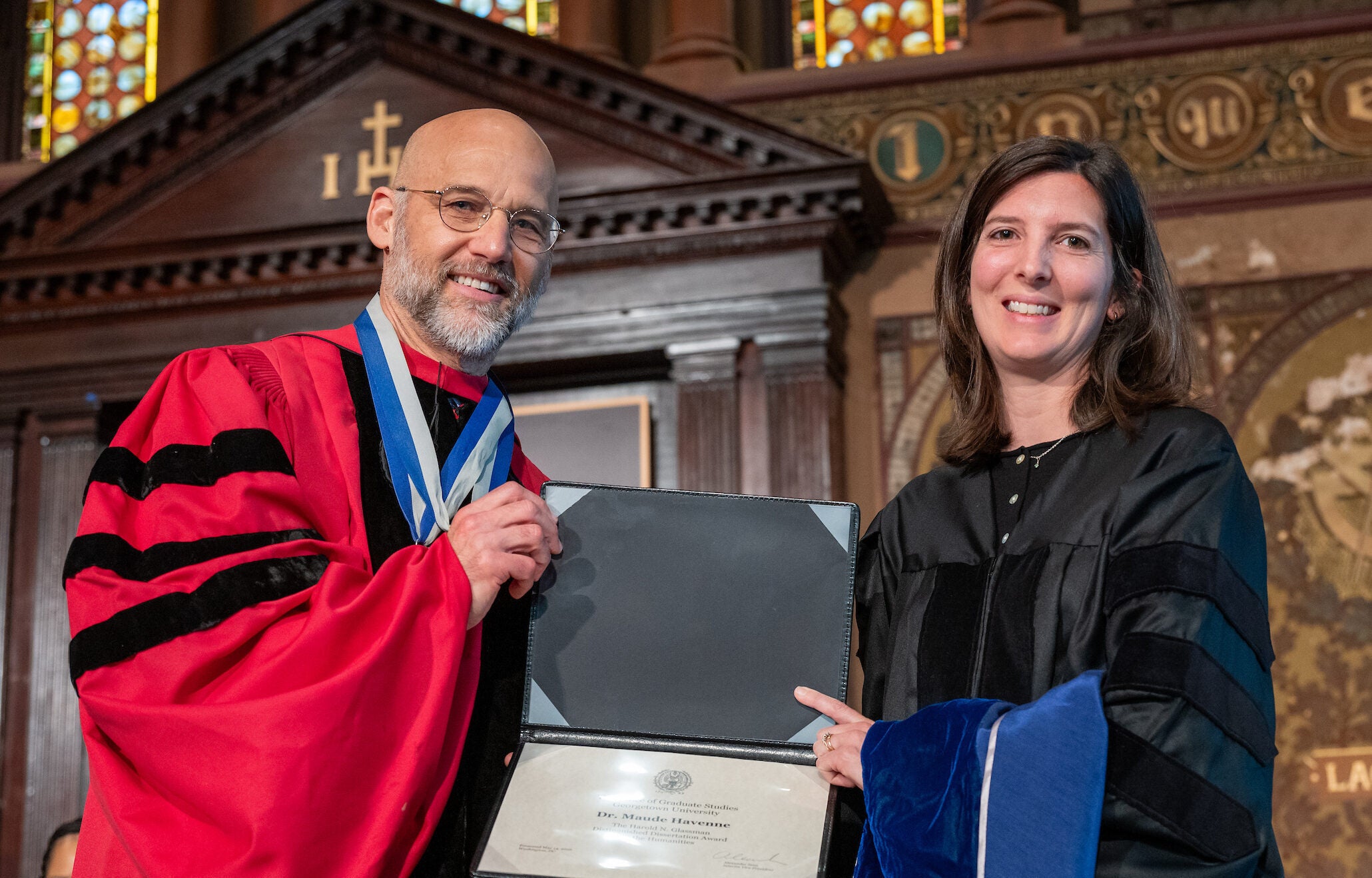
Last month, Georgetown Graduate Studies recognized these dissertation authors with the Harold N. Glassman Distinguished Dissertation Awards during the annual Doctoral Hooding Ceremony.
The Glassman Awards are typically granted to three recent Ph.D. recipients across Georgetown’s doctoral programs. The Graduate Research Steering Committee selects one awardee each in the categories of humanities, sciences and social sciences for remarkable scholarly work that makes innovative or outstanding contributions to the author’s field.
The 2026 winners are Maude Havenne (G’24), who studied Spanish literature and cultural studies, in the humanities; Ellen Jacobs (G’24), who studied biology, in the sciences; and Natascha de Vasconcellos Otoya (G’25), who studied environmental history, in the social sciences.
Meet the honorees who are now teaching and researching around the globe, and learn how their doctoral research shaped their careers.
Maude Havenne: Reclaiming Disgust as Colonial Critique
Havenne is an expert in the “eek.”
The “eek reflex,” as she calls it, is part of the human response to something perceived as disgusting. But in a historical context, disgust is a learned cultural construct used to dehumanize the native people of colonized nations, Havenne argues.
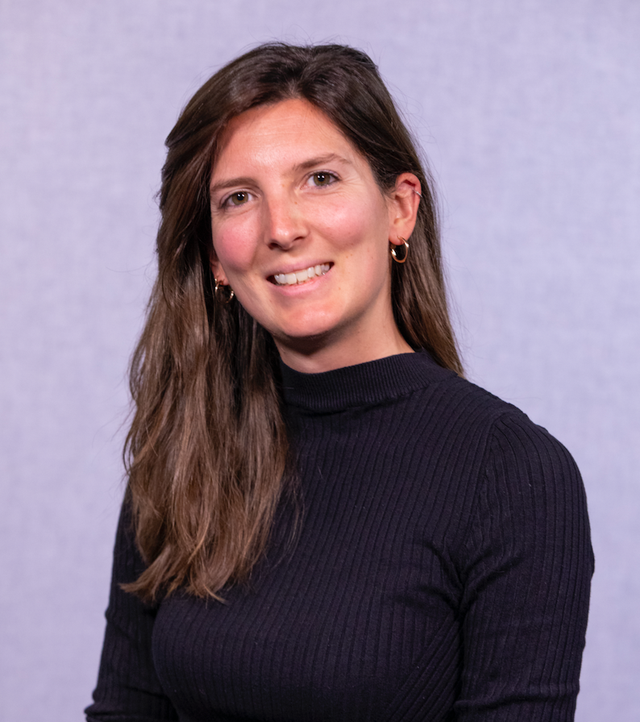
A headshot of Maude Havenne (courtesy of Maude Havenne)
Havenne’s dissertation examines the use of repulsive imagery in film, literature and other media produced by colonizing and colonized people in Spain, Belgium, Equatorial Guinea and the Congo. These depictions of disgust are political weapons that influence public opinion, Havenne writes, and postcolonial writers and artists have reclaimed this offensive imagery by turning it against their oppressors and revealing colonialism as violent and morally corrupt.
“Humans are taught what to consider disgusting since childhood,” Havenne said. “While de-learning disgust can be very hard, teaching younger generations about acceptance is a more manageable fight. I want to be part of that fight, and [receiving] the Glassman Award comforted me in this choice. If the academic world cares about disgust and postcolonial literature, so does the rest of the world.”
Professor Alejandro Yarza, who mentored Havenne with Professor Adam Lifshey, called Havenne’s research “groundbreaking in the way it rethinks disgust not as a mark of the colonized subject, but as a powerful critical language through which colonial violence itself is exposed.”
Havenne, from Belgium, started her Ph.D. in 2018. She was drawn to Georgetown by its DC location and interdisciplinary faculty. At Georgetown, she worked with the Prisons and Justice Initiative and interned at several non-governmental organizations while writing her dissertation.
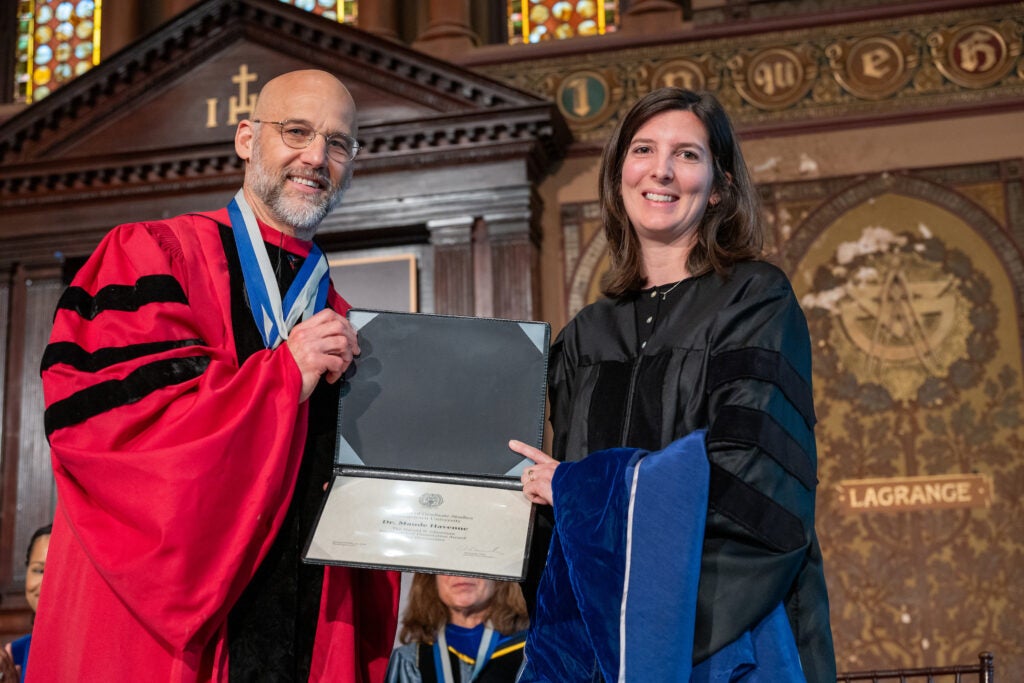
Maude Havenne receives her Glassman Award from Alex Sens, interim vice president for graduate studies at Georgetown, at the 2026 Doctoral Hooding Ceremony.
She now works at Phillips Exeter Academy in Exeter, New Hampshire, teaching Francophone and Hispanophone literatures and cultures. Though she was offered a tenure-track faculty position at a research university after completing her Ph.D., she elected to teach at the high school level to have a greater impact.
“I am hoping that teaching students about cultures other than their own in their most formative years can make a difference,” Havenne said. “Through the students’ interactions, I am learning about ways to make my research exciting and effective among heterogeneous audiences. It is not easy, but it is a wonderful challenge!”
Ellen Jacobs: Investigating Dolphin Development and Tool Use
Baby mammals learn a lot from their mothers, and dolphins are no exception. However, dolphin calves have more say in how their mothers care for them than previously thought.
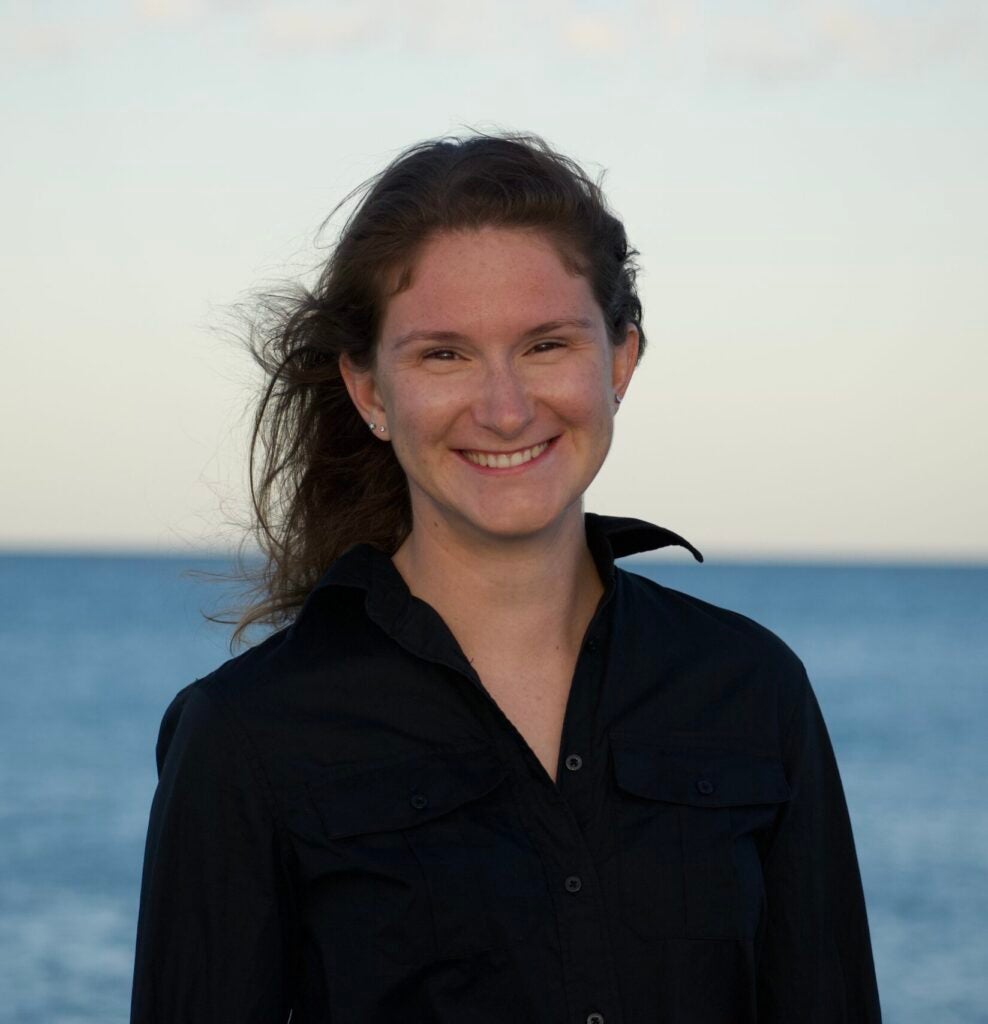
Ellen Jacobs (courtesy of Ellen Jacobs)
Using detailed observation of bottlenose dolphins and hierarchical statistical modeling, Jacobs’ dissertation uncovered that dolphin calf characteristics, including age, sex and health, dictate how dolphin mothers care for their individual offspring.
Part of this care includes teaching calves the complex task of ‘sponging,’ or how to use sea sponges as foraging tools. Sponging can distort the echolocation that bottlenose dolphins use to locate their prey, but Jacobs discovered that skilled calves learn to interpret these distortions over thousands of hours of observing their mothers’ sponging and become more successful foragers as a result.
“My research felt quite niche at the time I was working on it, so it is really meaningful for the work to be recognized within the university,” Jacobs said. “I also hope that highlighting basic science research in the field of behavioral ecology can help to underline the importance of such research, especially in light of the current funding climate in the U.S. right now.”
Her advisor, Professor Janet Mann, said Jacobs’ dissertation addressed “fundamental questions that have stumped [marine biologists] for a long time.” Jacobs’ discoveries demonstrate her “creativity, insight and intelligence in tackling exciting questions about the natural world,” Mann said.
Jacobs began her Ph.D. at Georgetown in 2019, after completing a master’s in zoophysiology at Aarhus University in Aarhus, Denmark. She chose Georgetown to work with Mann and her research team in Shark Bay, Western Australia.
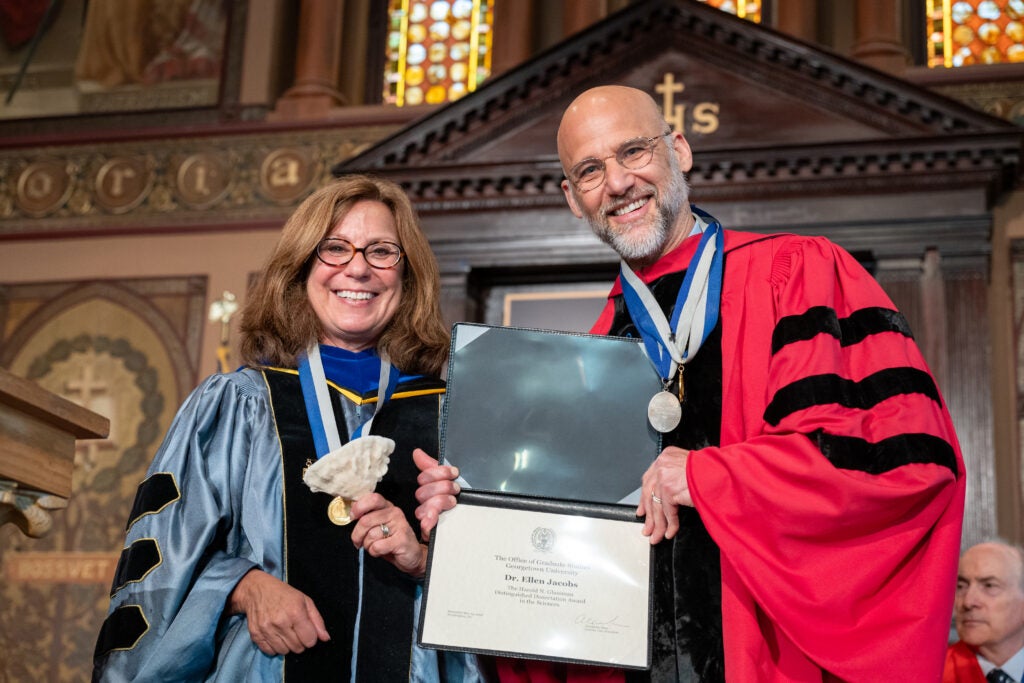
Distinguished University Professor Janet Mann, holding a sea sponge, accepts Ellen Jacobs’ Glassman Award from Alex Sens during the 2026 Doctoral Hooding Ceremony.
Jacobs returned to Aarhus University in 2025 as a postdoctoral researcher. There, she applies the research skills she learned at Georgetown to measure the impact of human-created noise on harbor porpoises.
“The extremely tight connection between behavior and environment underscores why it is so important to protect our marine ecosystems to help protect the animals in them,” Jacobs said. “Cutting funding to climate research will not stop the advance of climate change, and it is our responsibility to understand the delicate and complex systems we are trying to protect before they are gone forever.”
Natascha de Vasconcellos Otoya: Excavating Oil’s Layered History in Brazil
Few Ph.D.s can say they voluntarily learned about petroleum geology to augment their dissertation research, but Otoya can.
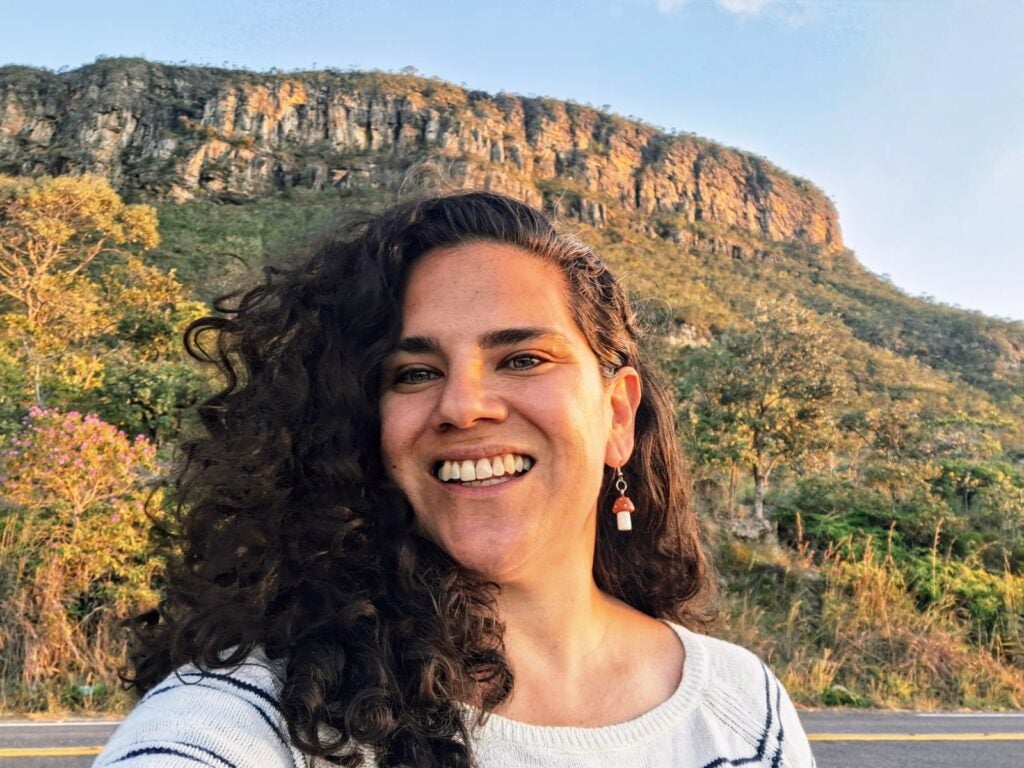
Natascha de Vasconcellos Otoya (courtesy of Natascha de Vasconcellos Otoya)
To better understand Brazil’s history of oil, Otoya added geologic science to her research portfolio that spans the social sciences, including environmental and economic histories. She also explored and photographed Brazil’s abandoned oil fields by bicycle, adding audiovisual production to her skill set.
Otoya’s dissertation chronicles the environmental history of Brazil’s oil fields from the early Cretaceous period to the Anthropocene. The format of her dissertation mimics its subject matter: Each chapter represents a layer of oil history, following the stacked geological structures that allowed oil to form in the region.
“The dissertation is unconventional in many ways: It spans 150 million years of history, there are first-person accounts of the ‘behind the scenes’ of the research at the end of each chapter, [and] I included a soundtrack as part of the package sent to the committee,” Otoya said. “I was not sure how all this ‘artistic license’ would land on readers, but it seemed to have moved them enough to be awarded. I’m super happy about it!”
Professor John Tutino, a member of Otoya’s dissertation committee, called the work “the most innovative dissertation I have read in four decades of working with doctoral students at Georgetown.” Otoya’s advisor, Distinguished University Professor John McNeill, called it the first work he knows of “palimpsestian history,” referring to the dissertation’s incremental layers.
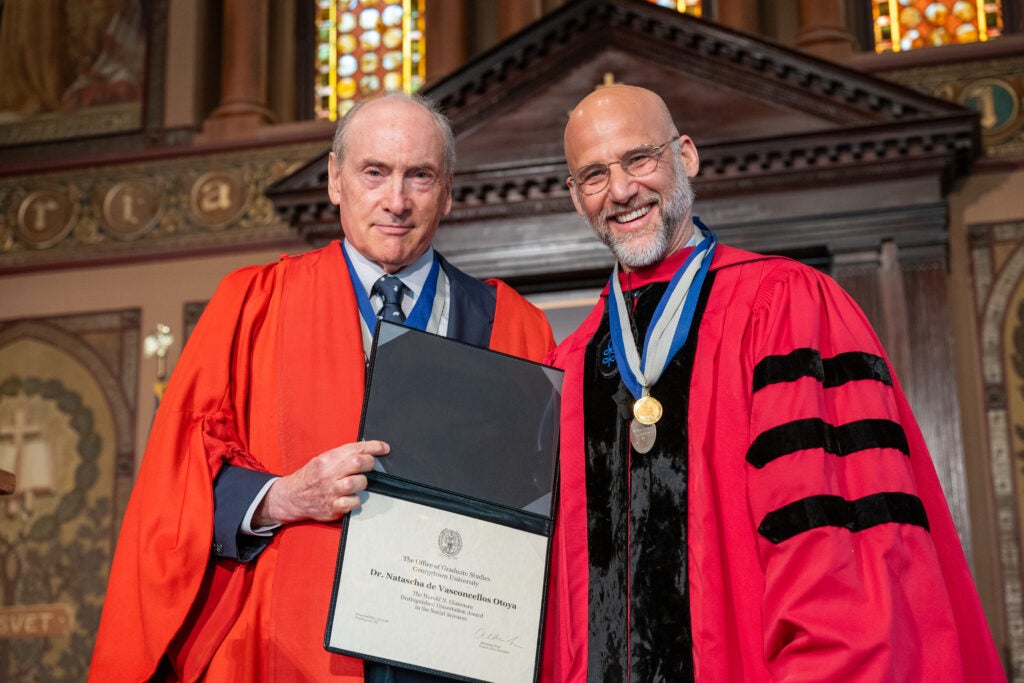
Distinguished University Professor John R. McNeill accepts de Vasconcellos Otoyas’ Glassman Award on her behalf during the 2026 Doctoral Hooding Ceremony.
Otoya, from Brazil, started her Ph.D. at Georgetown in 2017. She specifically wanted to work with McNeill, whose work she admired as a student of environmental history in Rio de Janeiro.
She returned to Brazil after her Ph.D. for a postdoctoral researcher role at the Universidade Evangélica de Goiás. Otoya now studies the Cerrado, an extensive savanna in central Brazil, and its rapid conversion into industrial farmland for exported agriculture. Continuing the novel research formats she explored in her dissertation, she films her bike rides through the Cerrado.
“One of the tenets of environmental history is the effort to decenter human action and insert human activity back in nature — looking at the fuller picture and recognizing that humans are never alone in making history,” Otoya said. “Everything on the face of the Earth has a history.”