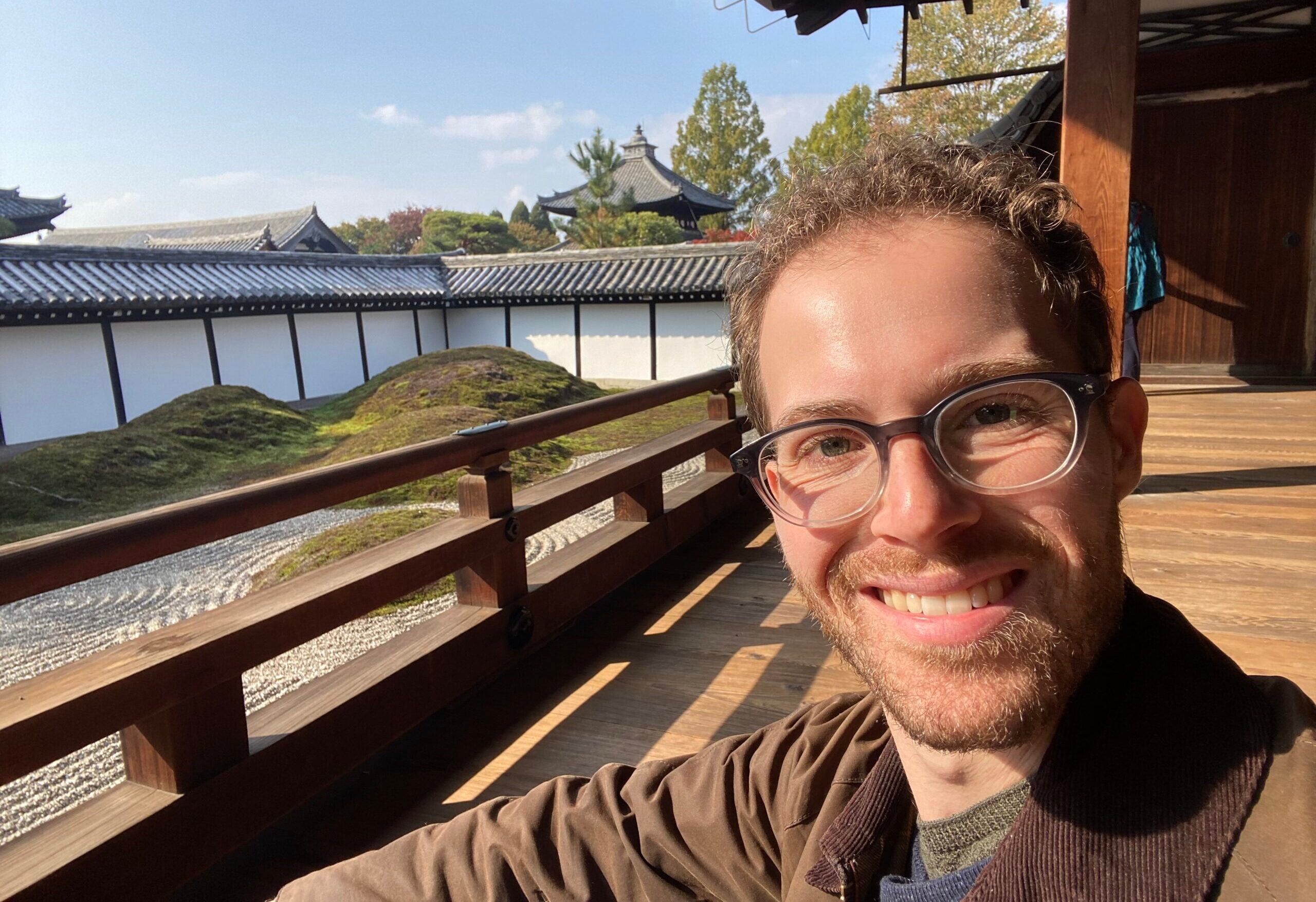
Seaweed, Colonialism and a Fulbright Grant Bring Ph.D. Student to Japan’s Cultural Capital
Ethan Barkalow (G’28) first encountered Japanese culture in a Wakefield, Massachusetts, sushi restaurant in elementary school. He loved the restaurant so much that he profiled its chef, a Japanese immigrant, for his sixth-grade newspaper.
As Barkalow grew up and learned more about Japan, he became fascinated with the complexity of Japan’s language and history. Studying Japanese language and culture in college, and visiting the country through a department trip as an undergrad, only strengthened these interests.
Now a Ph.D. candidate in history at Georgetown, Barkalow is spending a year immersed in Japanese language, history and culture through the Fulbright U.S. Student Program. The dissertation grant enables Barkalow to work closely with scholars at his host institution, Kyoto University, and access valuable primary sources across the country for his research into the coastal history of the Korean Peninsula during Japanese colonial rule.
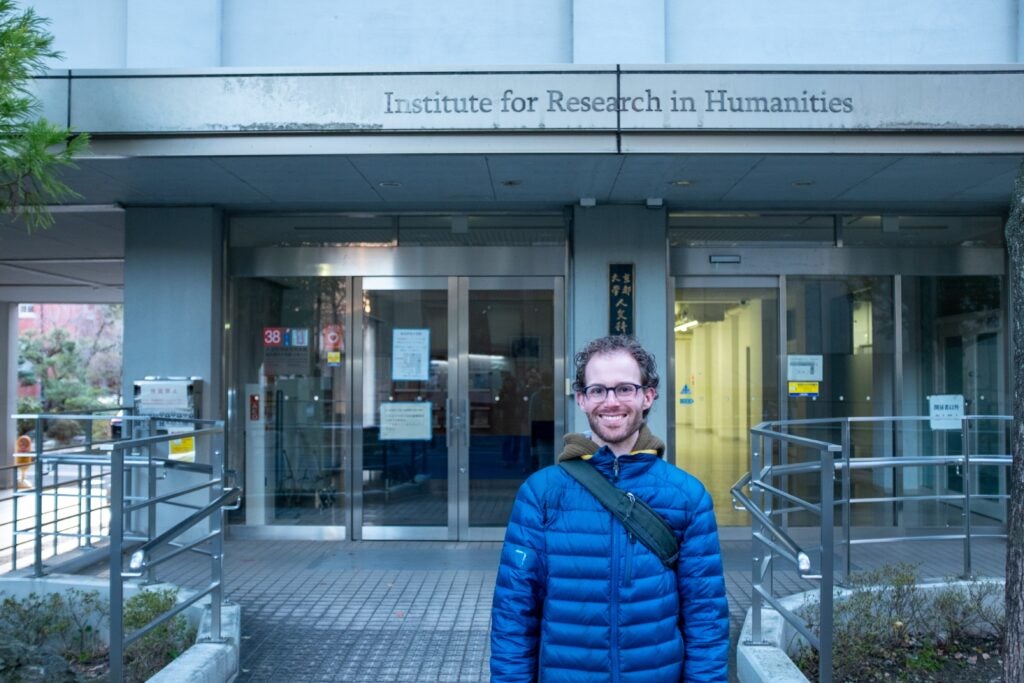
Ethan Barkalow (G’28) outside the Institute for Research in Humanities at Kyoto University, his host institution for the Fulbright grant. (Courtesy of Ethan Barkalow)
Since he arrived in Kyoto in November 2025, Barkalow has embraced every opportunity to engage with Japanese culture, from biking around Kyoto to celebrating major holidays at Shinto temples. For him, the experience has been a perfect balance of academic and personal fulfillment.
“It makes a world of difference to be immersed in a place where it feels like everything is relevant to my project and encouraging me,” Barkalow said. “I feel like I have exactly the right amount of connection and involvement with scholarly activities and social engagement.”
Diving Into Original Sources
By examining Japan’s imperial past and the social and environmental legacies of its colonization of Korea, Barkalow hopes to shed light on the enduring impact of Japanese colonialism in East Asia’s natural environment, including how Japanese culture values natural resources today.
Barkalow studies how Japanese colonization between 1910 and 1945 industrialized traditional Korean coastal industries like seaweed farming and fishing. While this period of rapid industrialization produced significant advancements in marine science and urbanization, it also threatened coastal ecosystems and challenged traditional Korean ways of life, Barkalow said.
“It takes the coastline as a serious unit of analysis: How did empire shape this part of the natural world?” Barkalow said. “And also, how did coastlines shape how Japanese colonial rule worked and how people in Korean colonial society experienced their lives?”
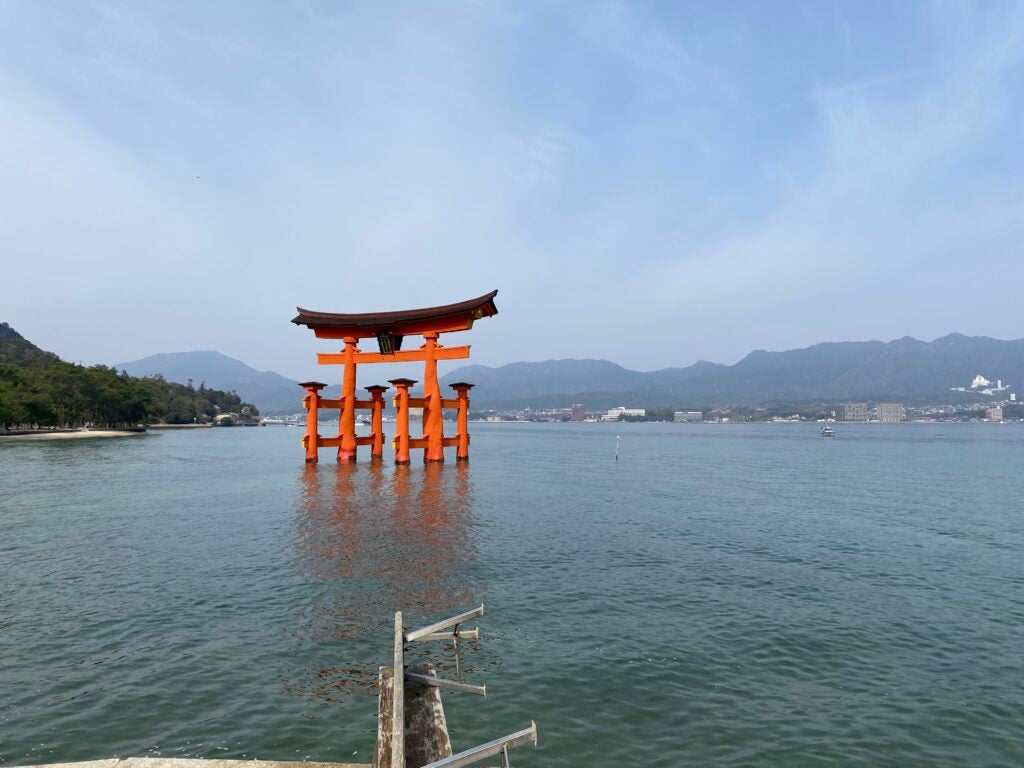
A torii gate at Itsukushima Shrine near Hiroshima, Japan. (Courtesy of Ethan Barkalow)
If anyone is equipped to conduct this research, it’s Barkalow, who is fluent in Japanese and Korean. Barkalow taught English in Kumamoto, Japan, from 2018 to 2020 through the JET Program and studied in Gwangju, South Korea, in 2023 through a State Department Critical Language Scholarship.
Barkalow selected Kyoto University as his host institution at the recommendation of his dissertation co-advisors at Georgetown, Professor Jordan Sand in the College of Arts & Sciences and Associate Professor Toshihiro Higuchi in the School of Foreign Service. Both Georgetown and Kyoto University have faculty with distinguished research expertise in environmental history, which is a developing focus within historical study, Barkalow said.
His program base at Kyoto University grants him access to the university’s extensive historic archive and the faculty support to probe new research leads.
Some of the primary research materials Barkalow depends upon haven’t been digitized and are only accessible through library appointments. When he discovers archival leads outside Kyoto, Barkalow hops on a high-speed bullet train to libraries in Tokyo or Kyushu.
“It makes a world of difference to be immersed in a place where it feels like everything is relevant to my project and encouraging me,” Barkalow said.
“I’ve been working in the School of Agriculture’s library at the University of Tokyo and found the most complete collection of a fisheries trade journal from the colonial Korean period,” Barkalow said. “These are really valuable sources, because they show people working in coastal industries and fisheries and talking about what they’re doing. All of the advertisements show what these people are interested in buying and what their world is like. It’s so interesting.”
Living Like a Local
When he’s not poring over library archives across Japan, Barkalow can be found pedaling Kyoto’s scenic streets on his bicycle, attending social events for his department at Kyoto University or seeking out new “matsuri,” traditional festivals that commemorate religious or cultural holidays.
“Anytime I hear about something that’s accessible to an American abroad, and that I haven’t experienced before or don’t know much about, I try to go,” Barkalow said.
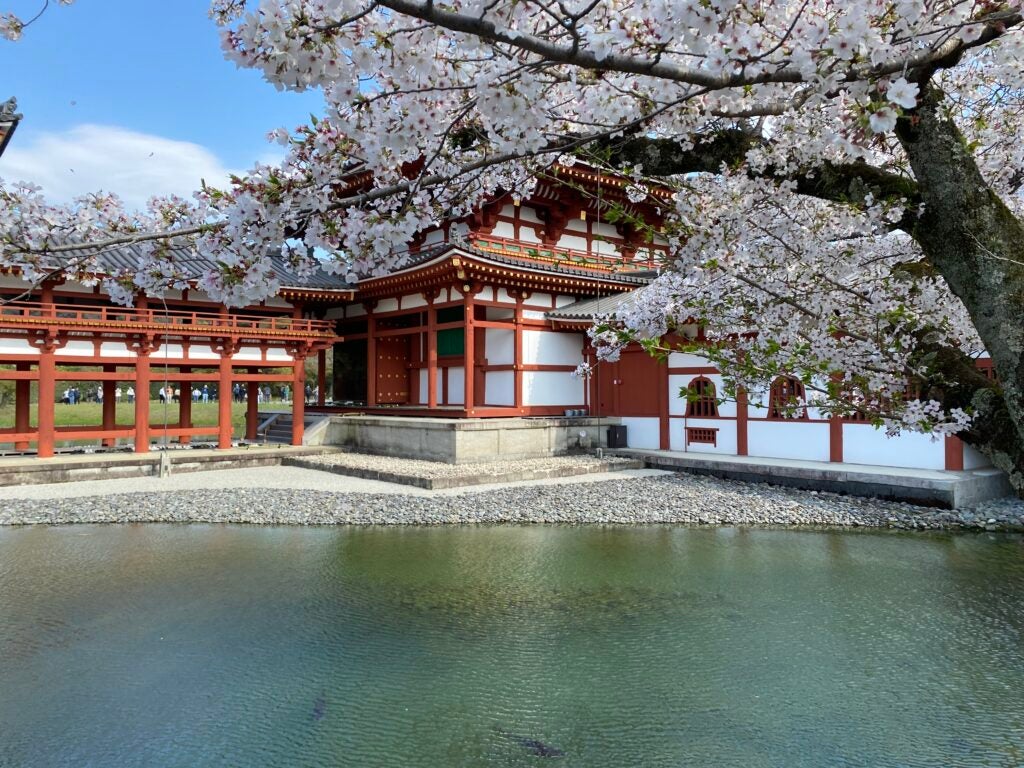
Cherry blossoms bloom outside Byōdo-in Temple in Uji, Japan. (Courtesy of Ethan Barkalow)
Kyoto is the cultural center of Japan and has offered Barkalow many opportunities for engagement. Shortly after arriving in the city, Barkalow and a fellow American exchange student attended Kūya Yuyaku Nenbutsu, a traditional prayer performed in chant and dance by Buddhist monks to ward off illness.
On New Year’s Eve 2025, Barkalow celebrated Okera Mairi at Yasaka Shrine in Kyoto alongside locals and visitors from across Japan and the globe. The annual late-night festival ushers good fortune and health into the new year.
“There’s just a massive New Year’s Eve prayer, where you basically burn a little prayer rope and take it with you to hang it in your home,” Barkalow said. “Thousands and thousands of people attend, and it was really interesting to witness and experience.”
Cultural Convergence
Barkalow views every interaction during his Fulbright experience as an opportunity to foster intercultural collaboration and understanding between Japanese and American citizens.
He’s planning a trip to Kumamoto to reconnect with the community members he taught and lived among during his JET Program, including singers in a local glee club he previously joined.
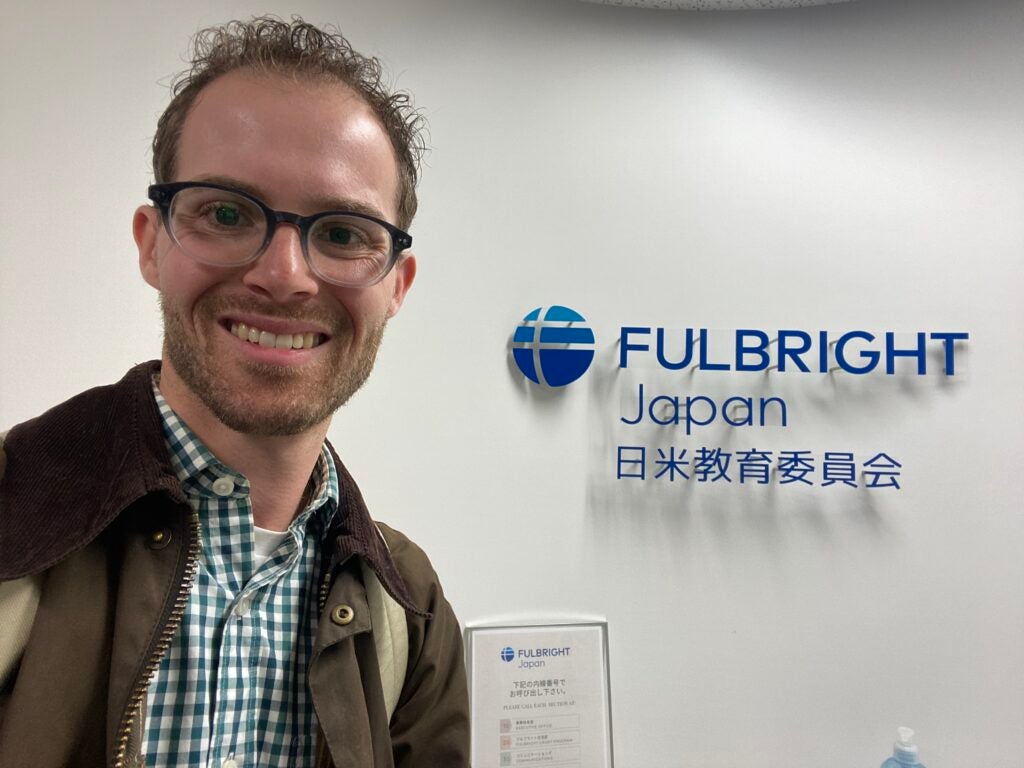
Barkalow arrived in Japan to start his Fulbright term in November 2025 and will study in the country for about a year. (Courtesy of Ethan Barkalow)
“It will be wonderful to see those folks again,” he said.
After completing his Ph.D., he hopes to teach Japanese environmental history at a university in the U.S. and establish a research exchange program with a Japanese institution. Through his Fulbright Program, he has connected with more environmental historians and researchers and moved closer to making those goals a reality.
“I’ve gotten a lot of support, a lot of community and a lot of direction in my academic work through the Fulbright Program,” Barkalow said. “I would encourage anyone applying to do as much research as they can into forming that affiliation with a local university. The most important component is finding an affiliation that works with your needs for your project, but also your lifestyle and preferences.”