Who Can Access Health Care In Nigeria? Grad Student Uncovers Gaps to Help Local Doctors and Patients
Across Nigeria, patients face significant barriers to accessing life-saving primary care.
For one, there simply aren’t enough clinics: Nigeria has just 20,216 operational primary health care facilities to serve the country’s growing population of 242 million, according to a national health agency assessment. Even when patients can see providers, clinics may not offer the services they need.
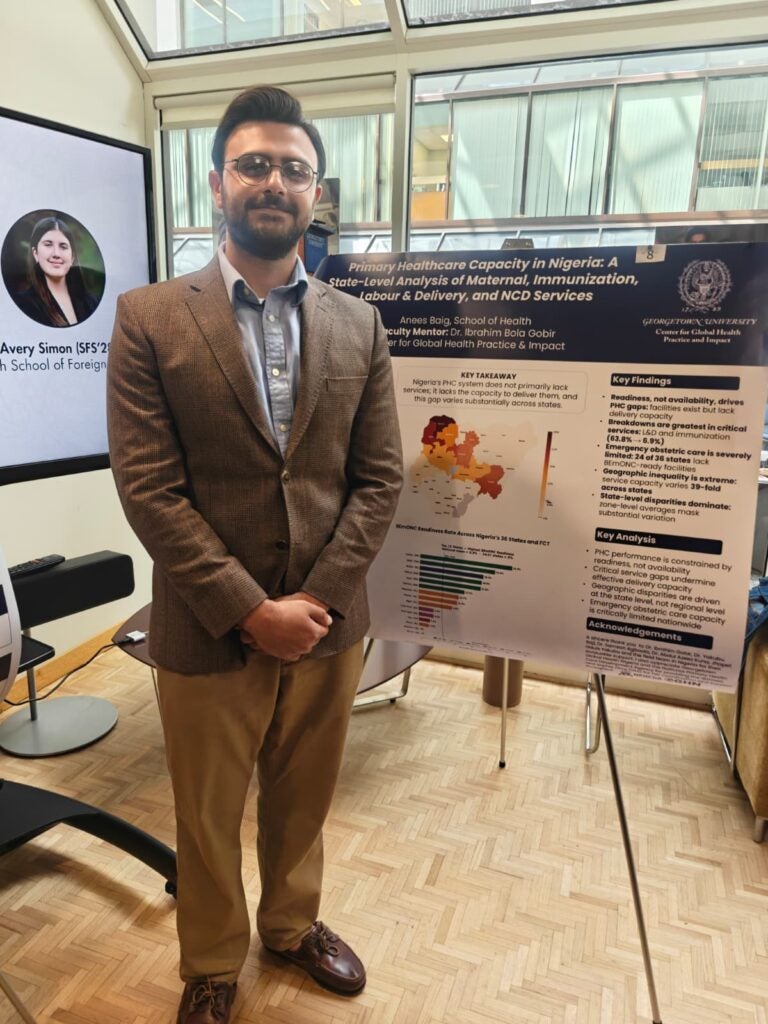
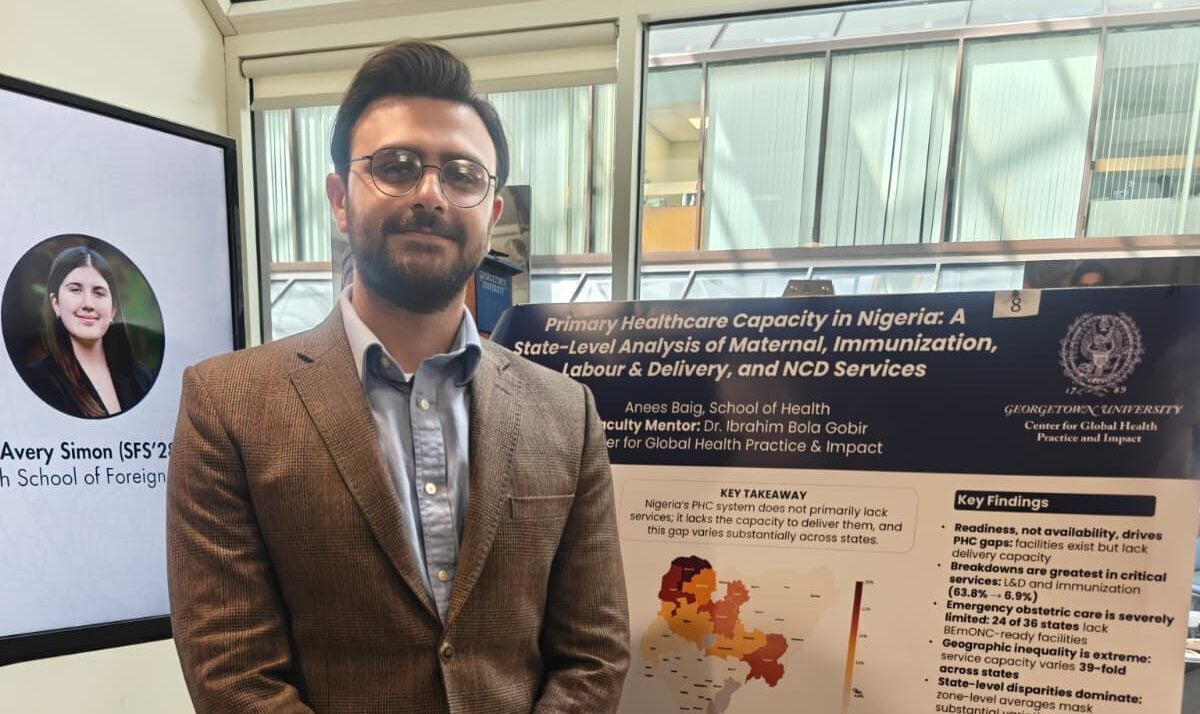
Anees Baig stands in front of his research poster during the spring semester showcase. (courtesy of Anees Baig)
Motivated to improve patient care countrywide, Anees Baig (G’26) spent the 2025-2026 school year analyzing state-level clinical service capacities across Nigeria’s 36 states and the Federal Capital Territory (FCT) through the Global Health Student Fellows program.
Baig, a candidate for the Master of Science in Global Health in the School of Health, assessed four vital domains of primary care: basic emergency obstetric and newborn care (BEmONC), immunization, labor and delivery and non-communicable disease screening.
“I found substantial variation across states in both service availability and readiness, suggesting that where someone lives strongly shapes the package and quality of primary care they can access,” Baig said. “In particular, some states demonstrated relatively strong capacity in maternal and immunization services but lagged in non-communicable disease care, highlighting a growing gap between traditional primary care functions and the rising burden of chronic conditions.”
A panel of global health experts at Georgetown awarded Baig’s work as the best final presentation at the Global Health Student Fellows End-of-Year Showcase in May. Baig credits the achievement to the support of his program mentor, Field Resident Director Dr. Ibrahim Bola Gobir with Georgetown’s Center for Global Health Practice and Impact, and the Georgetown Global Health Nigeria team.
Hear from Baig about his experience in the Global Health Student Fellows Program and how he hopes his research benefits Nigeria’s health systems.
What made you want to get involved in the Global Health Student Fellows Program?
I had my eye on the Global Health Student Fellows Program from the moment I arrived in Washington, DC, and started my M.S. in Global Health. I was actively looking for an opportunity that would broaden my horizons, connect directly to my coursework and help me produce research that was both publishable and relevant to primary health care and health systems in low- and middle-income countries.
The Fellows Program offered exactly that combination: structured mentorship, the chance to work on a substantive project in Nigeria and a platform to share my work with the broader Georgetown global health community.
How did you determine your research focus?
My research focus was ultimately determined through the Global Health Student Fellows Program’s project-matching process. As part of the application, I was asked to select three preferred projects from a broader set of research opportunities.
I was particularly drawn to projects that aligned with two areas I wanted to explore further: the use of artificial intelligence and emerging technologies to augment health care delivery, and the use of data to better understand primary health care systems in low- and middle-income countries. The Nigeria project was especially exciting because it gave me the opportunity to work with a large national dataset and examine disparities in access to essential primary care.
Later, Dr. Gobir, the Georgetown Global Health Nigeria team and I determined which dimensions of primary health care would be most meaningful to analyze.
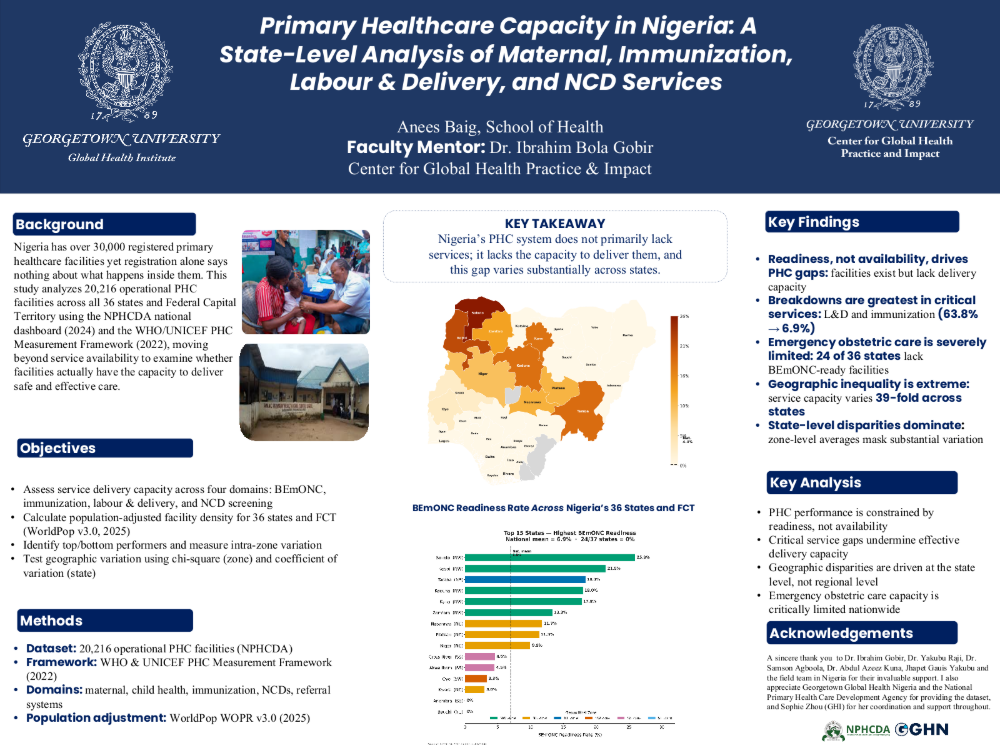
Baig’s research poster (courtesy of Anees Baig)
How do you hope that your research benefits patients and health care providers in Nigeria?
These findings underscore the importance of targeted investments, better subnational planning and stronger routine data systems to ensure that primary health care is comprehensive and equitable.
I hope this work contributes to more nuanced, state-specific strategies for strengthening primary health care so that resources and technical assistance are directed to the gaps that matter most for maternal, child and chronic disease outcomes. By making subnational disparities visible, I hope to support policymakers, implementing partners and advocates who are working toward more equitable service delivery.
What implications does your research have for U.S. agencies and organizations that support health care access in Nigeria?
I hope the research encourages a shift from one-size-fits-all approaches toward models that are co-designed with local stakeholders, responsive to state-level data and focused on long-term system strengthening rather than short-term vertical programming.
What did you find most rewarding about participating in the Global Health Student Fellows program?
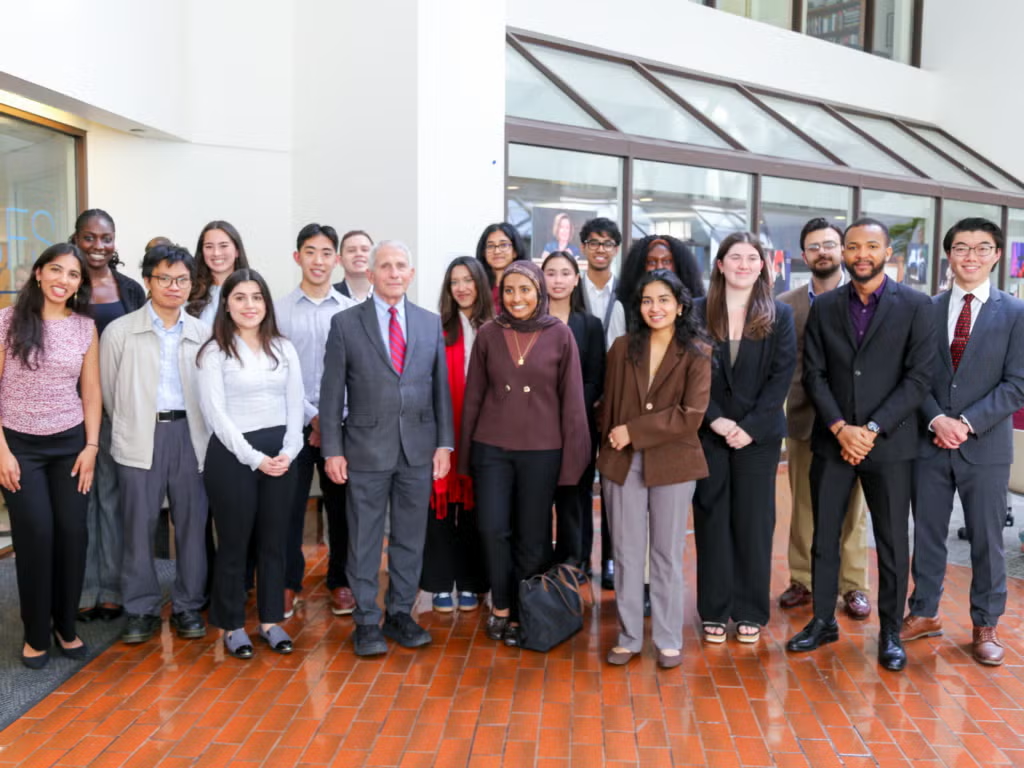
Global Health Student Fellows program participants pose for a photo with Dr. Anthony Fauci (H’90), M.D., Distinguished University Professor at the School of Medicine and McCourt School of Public Policy. Anees Baig is the third student from the right. (Photo courtesy of the Global Health Institute)
The most rewarding part of the program was the community and mentorship. I was able to interact closely with other student fellows at events throughout the year, which exposed me to diverse global health projects and helped me refine how I present my own work.
Just as importantly, working with my mentor and his team in Nigeria gave me grounded insight into how primary health care data and evidence are used in practice, and they pushed me to make sure my analysis spoke to real implementation challenges.
I also felt incredibly privileged to meet [Distinguished University Professor] Dr. Anthony Fauci through Georgetown’s global health programming. His career is a testament to the importance of rigorous, evidence-based public health leadership, and it has inspired me to think about my own career trajectory in that light.
How did the program add to your graduate experience at Georgetown?
Altogether, the Global Health Student Fellows program augmented my graduate experience by turning what I was learning in the classroom into a collaborative, applied research experience with direct relevance to policy and practice.
What’s next for you after you complete your master’s degree this fall?
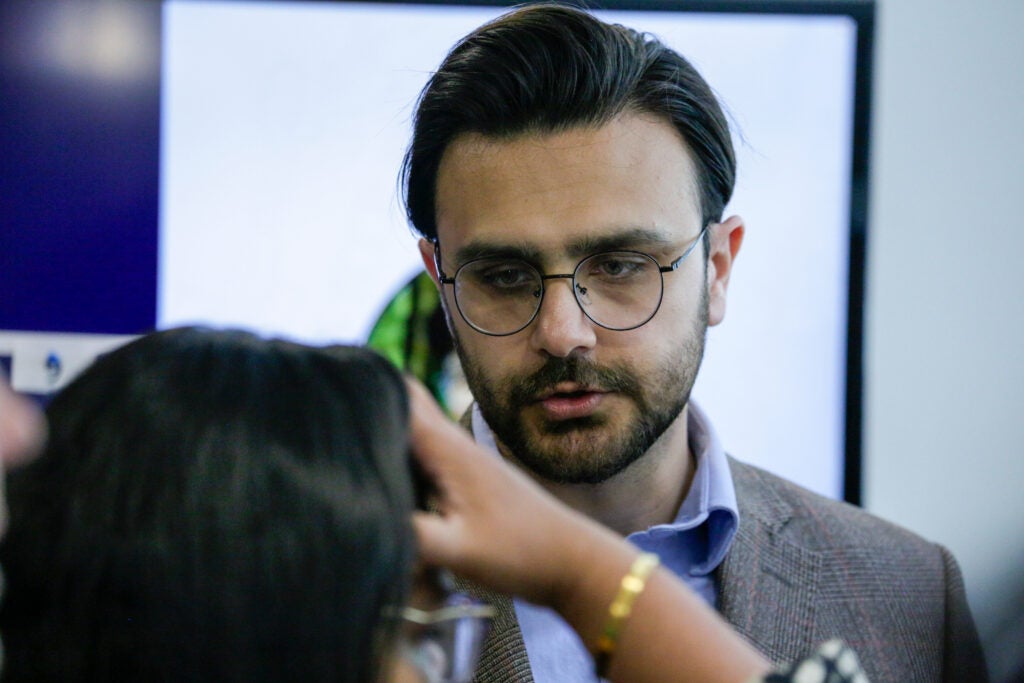
Baig speaks with an attendee during the Global Health Student Fellows End-of-Year Showcase in May 2026. (photo courtesy of Anees Baig via the Global Health Institute)
After my M.S. program, I plan to work with a multilateral organization, such as the World Bank or the Asian Development Bank, on strengthening health systems and primary health care access in low- and middle-income countries.
I’m particularly interested in roles that sit at the intersection of research, operations and policy, where I can help design, analyze and implement programs that advance universal health coverage and more resilient, equitable health systems.
In the longer term, I hope to continue partnering with ministries of health and global health agencies to support data-driven decision-making for communities in lower-income countries that are working to build stronger, more inclusive health systems.