COVID-Era School Closures Have Lingering Impacts On Children’s Development, Georgetown Doctoral Researcher Finds
Nearly five years after schools reopened during the COVID-19 pandemic, students who were in early elementary grades in 2020 and 2021 are experiencing lasting effects from pivoting to remote learning during a critical period of development, research from a recent Georgetown Ph.D. graduate shows.

Anna Wright (courtesy of Anna Wright, credit Jason Meek Photography for the Association for Public Policy Analysis & Management)
Psychology researcher Anna Wright (G’23, G’26) and members of Georgetown’s Context, Development & Social Policy Lab followed students from preschool through fifth grade using longitudinal data from the Tulsa, Oklahoma, school district.
In two separate studies, they found that 18 months of remote learning stunted literacy and math skills for early-elementary students and disrupted their development of executive functioning, a set of cognitive skills that allows kids to regulate their attention and behavior.
But the research also has a silver lining, said Wright, a graduate from Georgetown’s dual-degree Master of Public Policy and Ph.D. in psychology program. After schools reopened, students gradually resumed a rate of academic growth on par with normal benchmarks for their age.
Though the research suggests that the impact to executive functioning may be longer lasting, parents and teachers have many proven interventions to help children get back on track, Wright said.
“Kids are really resilient, especially when given the right support, and it’s easy to underestimate how resilient they are,” she said. “It’s not an ‘all hope is lost’ story. We’re all navigating this post-COVID world together, and I hope that is comforting for parents.”
How Were Kids Affected by School Closures?
The academic growth study surveyed children who were aged 4 to 6 before the pandemic and 8 to 11 afterward, tracking through 2023.
Accounting for several instructional variables, it found that children missed out on nearly three months of literacy growth and 14 months of math growth during school closures. Additionally, even after schools reopened, students’ individual rates of academic growth slowed from their pre-COVID trajectory before returning to expected levels within the two years surveyed.
These children also missed about a year of executive functioning growth during school closures, the second study found, even when they avidly participated in remote learning. When schools reopened, students continued to lag in developing these essential control, attention and cognitive flexibility skills, pacing about 70% slower on average than pre-pandemic.
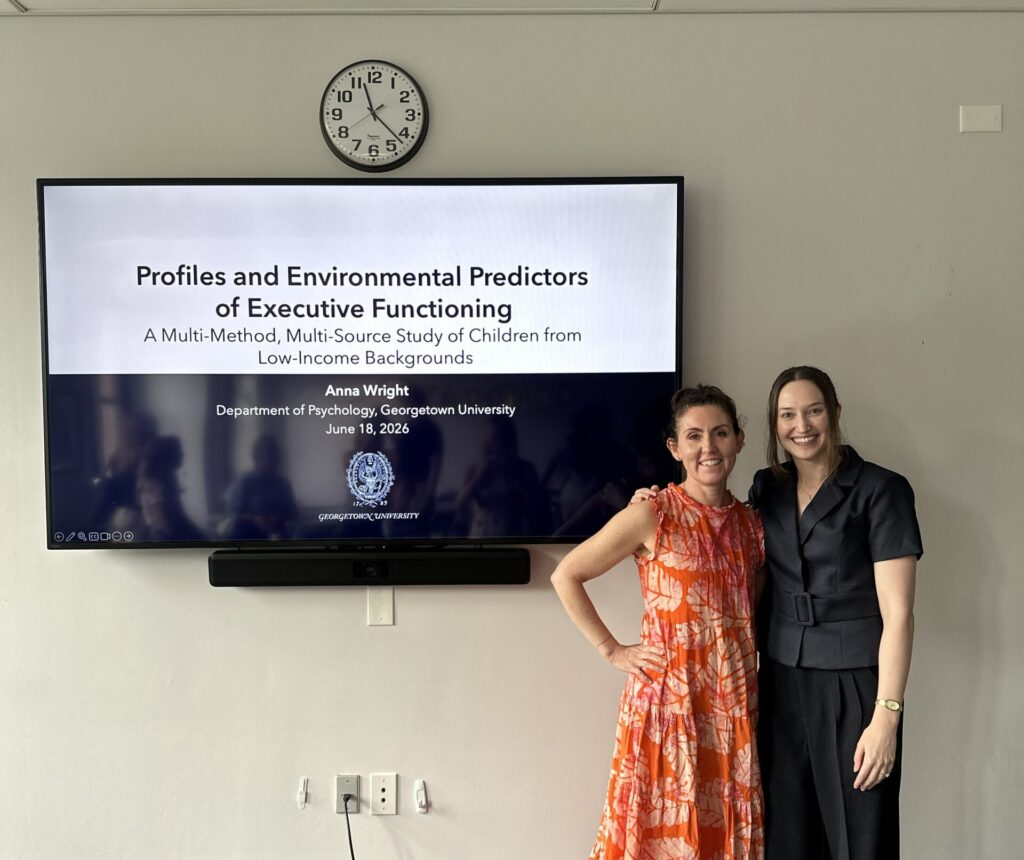
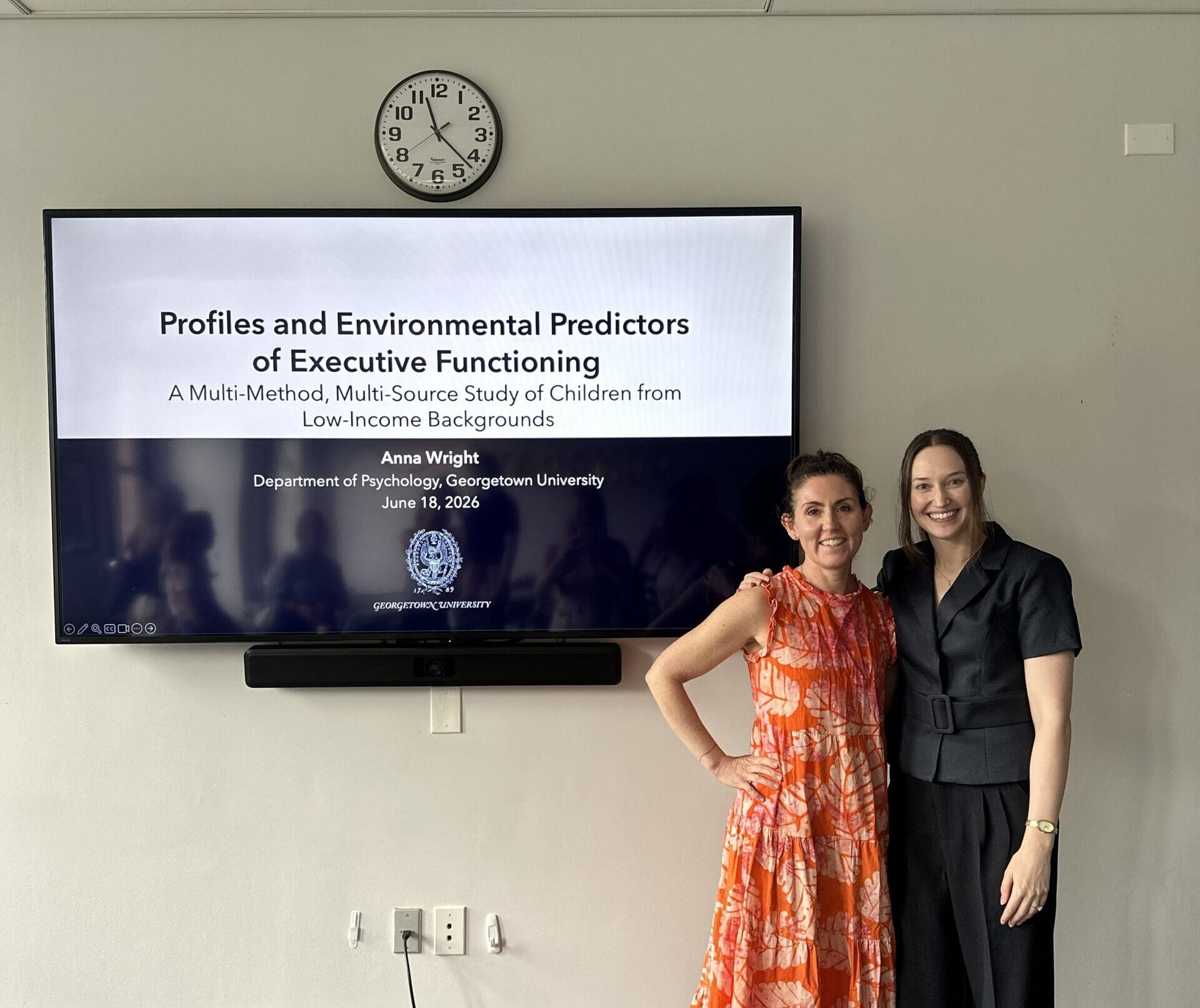
Johnson and Wright during Wright’s dissertation defense on June 18, 2026. (Photo courtesy of Anna Wright)
“Executive functioning and self-regulation skills are foundational precursors for kids’ abilities to learn academically,” Wright said. “As we recover from COVID as a society, we should be thinking about ways to support those skills: Having an organized classroom environment, providing coaching and modeling of self-regulatory and social-emotional skills and fostering responsive relationships between teachers and students.”
The body of research on COVID’s educational impact is growing, but these studies are groundbreaking for their use of longitudinal data from the Tulsa SEED Study that predates the pandemic, said lab lead Professor Anna Johnson, Wright’s mentor.
The federally funded study started as a project to assess the impacts of Oklahoma’s universal public pre-K on long-term child development, Johnson said. When the pandemic arrived, researchers already had an extensive database of public school students’ academic and developmental baselines.
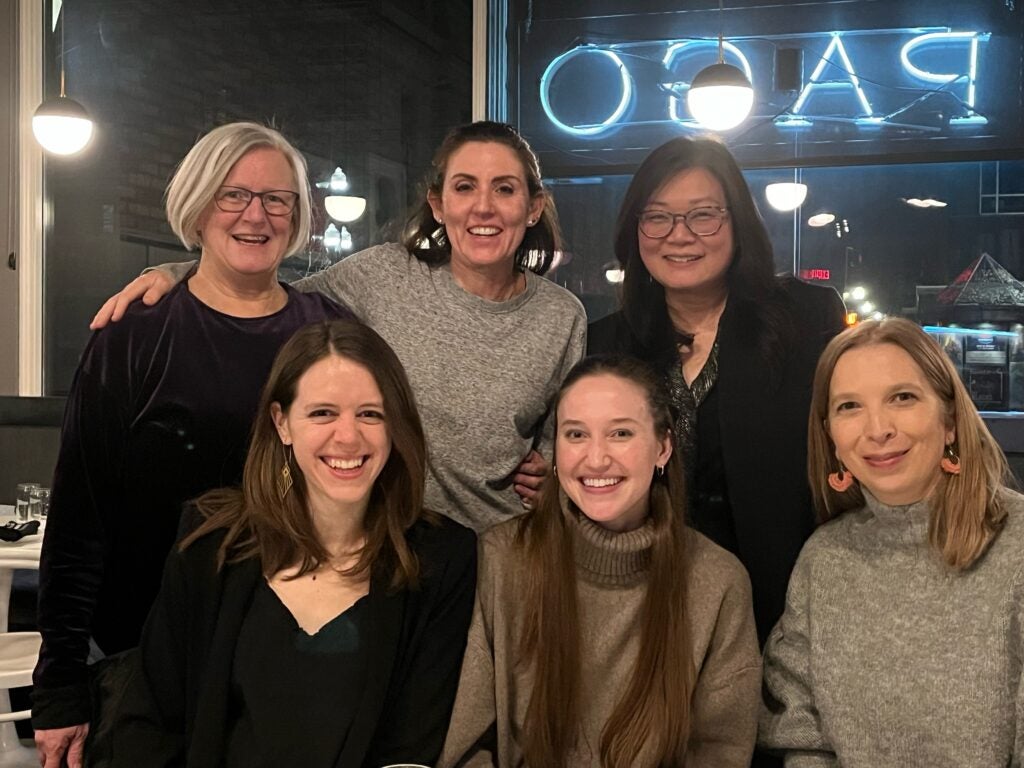
Johnson, top center, and Wright, lower center, meet with colleagues from the Tulsa SEED study during a visit to Tulsa, Oklahoma. Members of the Tulsa SEED study pictured are Diane Horm, Sherri Castle, Gigi Luk and Annie Partika. (Photo courtesy of Anna Wright)
“That gave us a really unique opportunity to look at not just how kids were doing after schools reopened after COVID, but also how they were doing relative to where they were before and where they would have been, in theory, in the absence of COVID,” Johnson said.
This research is also notable for focusing on students in a low-income, racially diverse area, she added. This demographic has historically been excluded from many similar research studies but represents a majority of public school students in the U.S.
Research with Policy Impact
Wright was drawn to Georgetown for the opportunity to pursue a Ph.D. at the intersection of developmental psychology and public policy.
Georgetown is one of few universities that offer a dual Master of Public Policy and Ph.D. in psychology, equipping student researchers to not only understand developmental science method and theory but also apply it in a broader societal and legislative context.
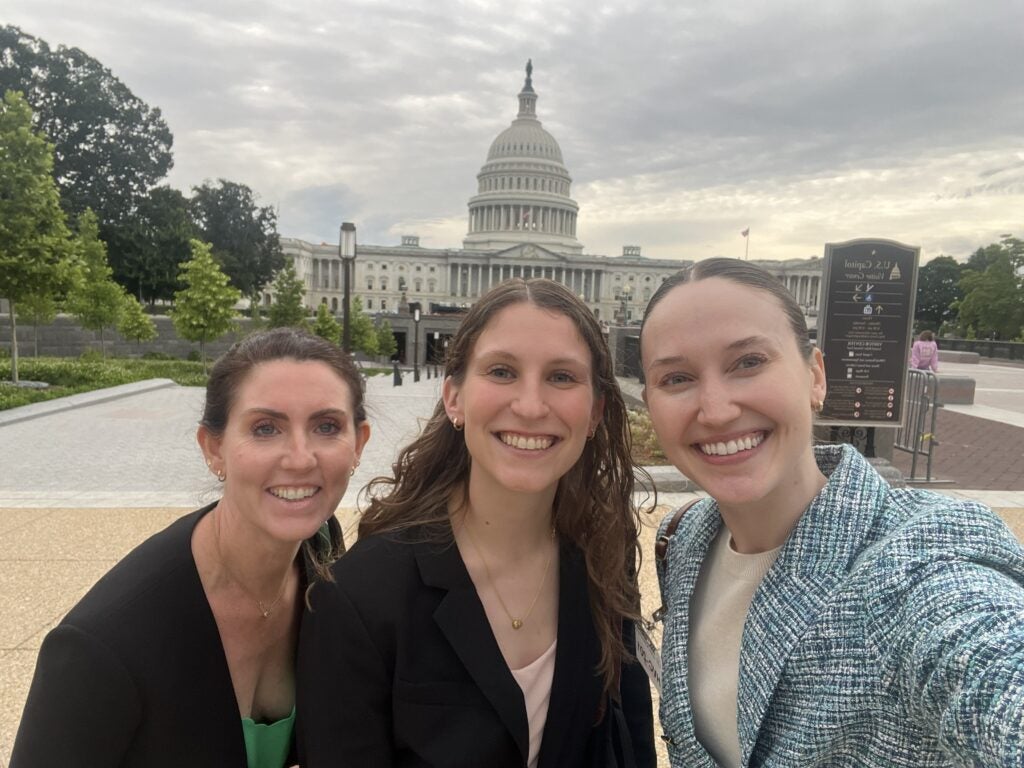
Georgetown Professor Anna Johnson, left, and recent Ph.D. graduate Anna Wright, right, appear at a Georgetown event for federally funded research on Capitol Hill in May 2025. In the middle appears Sophie Rodosky, another Ph.D. candidate and advisee of Johnson’s. (Photo courtesy of Anna Wright)
“Anna is really smart, and really motivated to understand how policy-amenable environments like schools can be improved to maximally support child development — particularly for families from low-resource communities who might be farthest from opportunity,” Johnson said.
Both studies include advice on how school systems and parents can support their children in recovering from skill stagnation, from offering targeted classroom tutoring to empowering parents to support their child’s math proficiency at home.
More generally, they advise that school districts nationwide should apply these lessons learned from the pandemic. School districts must “prioritize remote learning access for families with low resources in any future disaster that closes schools for an extended time,” one study reads.
“We try to really lean into our school district partnerships and use the data for actionable decision-making and educational policy-making,” Johnson said. “We let school districts and state education partners know how important the work they do is, and the data stands that up.”
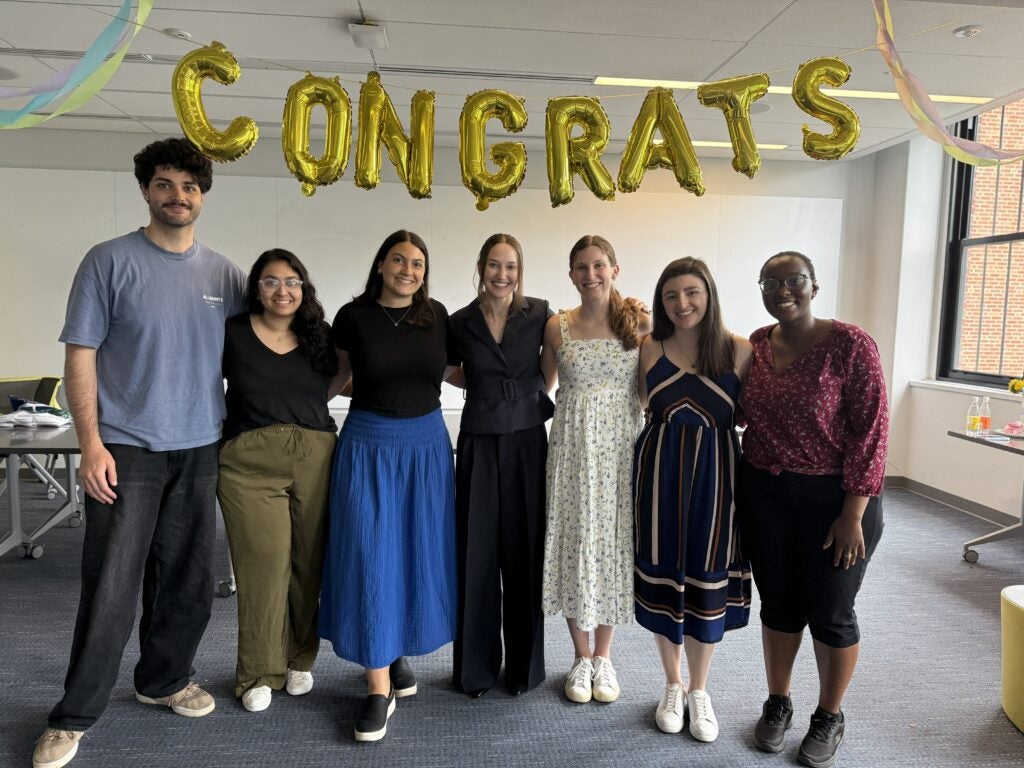
Wright, center, celebrates with fellow grad students from her lab after her dissertation defense. From left to right, the pictured students are Sebastian Reid, Sarah Kazi, Bella Gonzalez, Wright, Rodosky, Katherine Hayes and Cassia Caruth. (Photo courtesy of Anna Wright).
What’s Next for Wright
Wright successfully defended her dissertation in June and is headed to a postdoc position at the Institute for Social and Health Equity at the University at Albany in New York.
There, she will research bullying and victimization in elementary schools. Wright also hopes to study health and environmental equity, in line with another study she published during her doctorate that focuses on air pollution’s effect on low-income kindergarteners’ development.
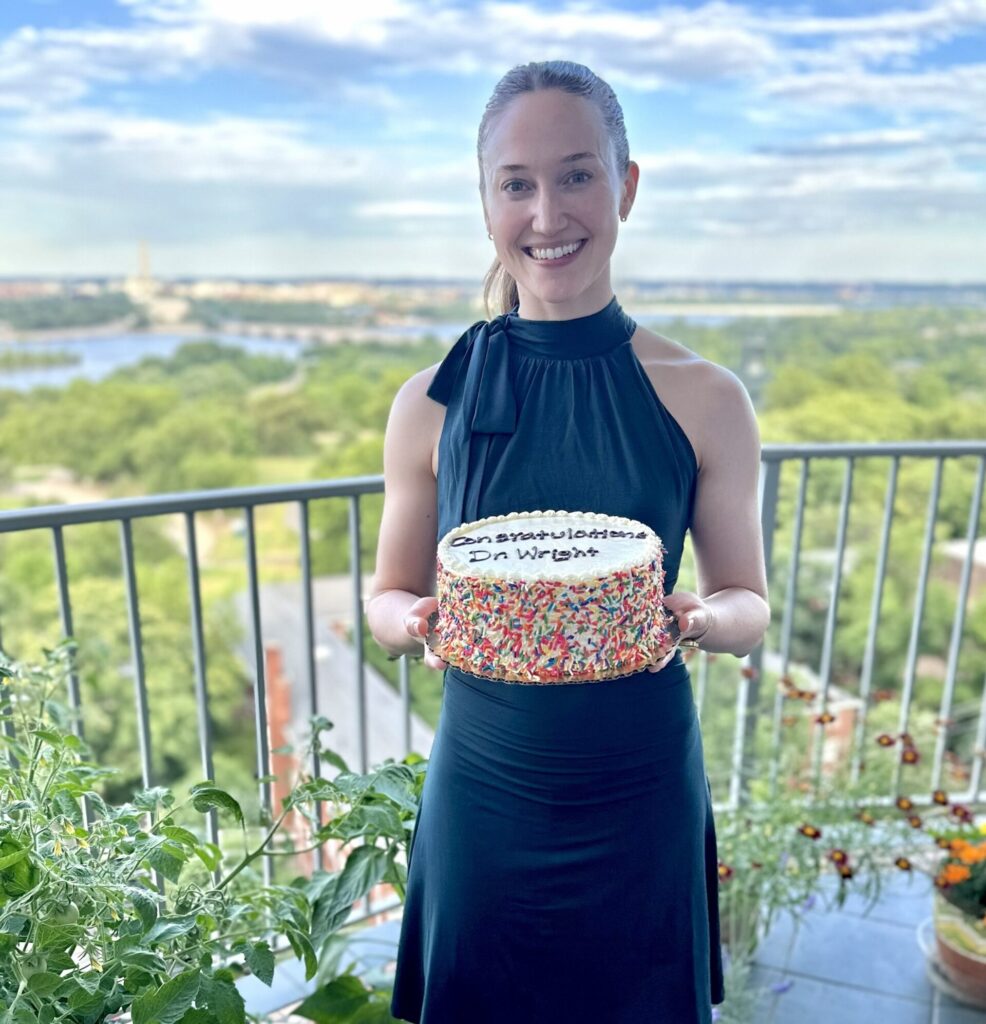
Wright celebrates after her successful dissertation defense in June 2026. (Photo courtesy of Anna Wright)
The multidimensional training Wright received during her MPP/Ph.D. will be essential as her career progresses, she said.
“Georgetown really prioritizes interdisciplinary thinking, which has been foundational for the way that I approach my work,” she said. “And the people are so awesome. I’ve had so many professors and mentors I’ve encountered along the way that have helped to shape me as a scholar and a person in ways that I never would have expected.”