
To Take the Pulse of Violent Trauma, Nurse Transfers from the Trauma Bay to the Classroom
Graduate student Kenyatta Hazlewood (G’28) finds purpose in chaos.
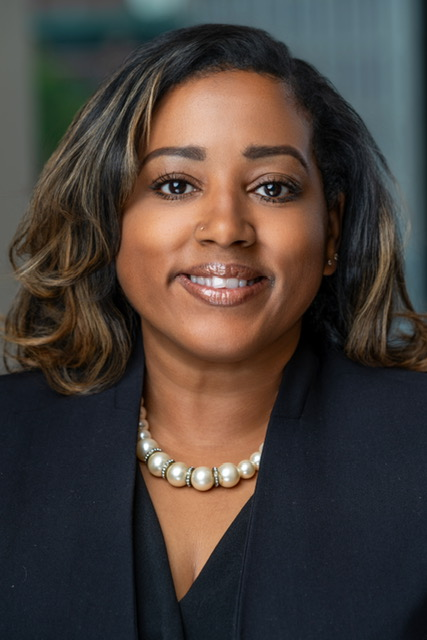
Georgetown graduate student Kenyatta Hazlewood has 20 years of experience in trauma and emergency nursing. (Photo courtesy of Kenyatta Hazlewood).
During every shift in her 20 years working as an emergency and trauma nurse in the DC area, Hazlewood has faced tragic causes of injury and death: gun violence, car accidents, sexual assault and domestic and substance abuse. Every shift, she strengthened her resolve to give more of herself to help people on the worst day of their lives.
“Trauma crosses all disciplines,” said Hazlewood, the trauma program director at Howard University Hospital’s Trauma Center. “It crosses all races and income levels. We say it’s as diverse as a DMV office — it doesn’t matter who you are, you can be affected.”
Yet a lot of trauma is preventable by understanding and addressing its root causes, she said.
This fall, Hazlewood started her Ph.D. in nursing on Georgetown’s Capitol Campus to deepen her commitment to trauma prevention and intervention efforts and advance health equity through research.
Hazlewood is particularly interested in helping patients of color who have violent physical trauma, a population she frequently treats. Her dedication to resolving health disparities earned Hazlewood the Patrick Healy Graduate Fellowship, a merit-based program that supports students who may not otherwise be able to pursue a Ph.D.
Hazlewood had been eyeing doctoral programs for years, and the Healy Fellowship, plus the debut of Georgetown’s nursing Ph.D. program this year, gave her the means to follow her dream.
“I’m feeling grateful, honored, blessed and extremely, extremely fortunate to have this opportunity,” she said.
‘Their Stories Are What Motivate Me’
Pursuing a Ph.D. at Georgetown is a capstone to Hazlewood’s nursing career, and it also brings it full circle. Hazlewood’s foray into nursing began as a technician in MedStar Georgetown University Hospital’s emergency department in 2005, after earning her bachelor’s in health science from Howard University.
She then became a registered nurse while earning a second bachelor’s in nursing from Howard. Hazlewood embraced the quick-paced, high-stakes environment of emergency medicine and took every opportunity she could to work in the trauma bay.
“It’s a lesson in ultimate teamwork,” she said. “You need to listen to learn what happened and you need to observe. For the highest-level activations, you have everyone in the room: anesthesiologists, surgeons, surgery residents, medical students, nurses and nursing techs.”

Hazlewood speaks at a celebration of her nursing cohort in fall 2025. (Jonathan Newton/Georgetown University)
Hazlewood left MedStar Georgetown in 2008 to gain more trauma medicine experience at The George Washington University Hospital’s Trauma Center as a registered nurse team lead and charge nurse. She also joined medic teams at high-profile events, including gatherings in the U.S. Capitol and on the National Mall, and accompanied severely ill patients traveling internationally.
In 2010, Hazlewood’s teenage niece was killed in a preventable car crash. The loss inspired Hazlewood to understand how it happened and to become an advocate for trauma education and informed care.
Effective trauma care extends beyond addressing physical healing, she said, and addresses patients’ mental and environmental health.
“The same patterns of behavior that led to my niece being in that car are often similar to the circumstances that contribute to unfortunate choices and behaviors where people feel trapped or without options,” Hazlewood said. “I see patients in the trauma bay every day who, like my niece, are victims. Those with preventable injuries — gunshots, stabbings, assaults — that stem from a lack of resources and support stick with me in particular. Their stories are what motivate me.”
Community-Informed Care
Over the years, Hazlewood developed her expertise in trauma-centered care in various nursing roles at George Washington University Hospital, with stints at DC’s Transitional Housing Corporation and Dimensions Healthcare in Cheverly, Maryland.
She also joined advocacy organizations like the Society of Trauma Nurses and the Trauma Center Association of America and co-founded the District of Columbia Trauma Injury Prevention Coordinators Collaborative. Hazlewood found time between working and volunteering to earn her Master of Public Health from The George Washington University.
Throughout her experiences, Hazlewood has been focused on the socioeconomic factors that lead people of color to suffer violent physical trauma at higher rates than their white peers. Nurses are often patients’ first and most frequent contacts in the medical system and have great potential to shape patients’ mindsets and behaviors, she said.
“I believe nurses can help stop that cycle of violence,” Hazlewood said. “You first see a nurse when you’re a baby, then all the way up through school. How are we using school nurses, for example, to help get these messages out?”

Hazlewood with her fellow members of Georgetown’s inaugural Ph.D. in nursing program. From left: Kate Ellis, Sydney West, Edilma Yearwood, Kenyatta Hazlewood and Jennifer Wallace. (Jonathan Newton/Georgetown University)
Hospitals can promote healing and reduce risky behaviors by offering patients therapy, providing long-term case management and connecting patients to resources for financial, transportation and food security, Hazlewood said.
She implemented these practices on a large scale in 2016, when she became the director of trauma services at the Howard University Hospital. The following year, she helped start the Howard University Hospital Violence Intervention Program, which supports survivors of community violence during their hospital stay and after they are discharged.
In 2019, DC Mayor Muriel Bowser appointed Hazlewood chair of the inaugural Violence Fatality Review Committee, which addresses major barriers to violence prevention and recommends community-based solutions.
“Being able to be in the community and talk to people all the time, it helps me evaluate where we, as health care providers, are stepping up to help these populations,” Hazlewood said.
A Ph.D. With Purpose
At Georgetown, Hazlewood is zeroing in on the social determinants of health that cause the health inequities she’s witnessed throughout her career. She’s comparing different hospital-based intervention programs’ approaches to caring for at-risk patients.
“I’m looking at this marriage between public health and nursing that I’ve always tried to pursue,” Hazlewood said.
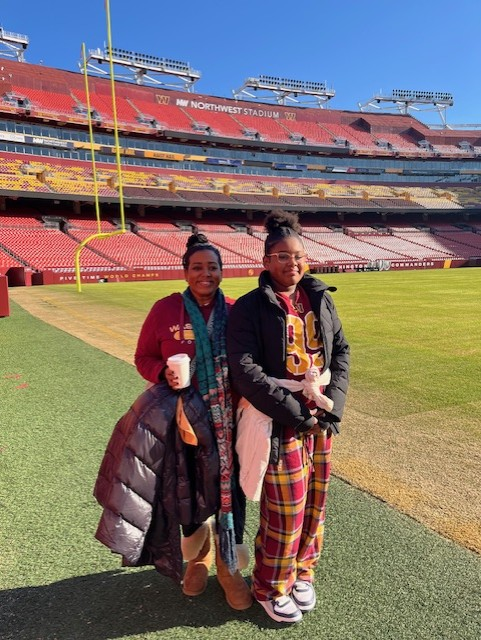
Hazlewood at a Commanders game with her daughter (Photo courtesy of Kenyatta Hazlewood)
In November, Hazlewood was named a Firearm Injury Prevention Research in Nursing (FIPRN) Scholar by the University of Colorado Anschutz. Through an intensive 12-week program next spring, she will learn about risk factors for gun violence, research-backed strategies to prevent injury and how to conduct community-engaged research that drives firearm injury awareness and prevention.
In addition to support from her husband, daughter and sisters, Hazlewood has “a couple of angels” cheering her on at Georgetown, she said.
One is her mother, whose experiences living with multiple sclerosis inspired Hazlewood to become a nurse. The other is a longtime nursing friend who attended Georgetown as an undergraduate and died following a struggle with depression earlier this year.
“These three years will mean something extra by having both my mom and her on my shoulder,” Hazlewood said.